What to forage in July
July is when foraging shifts into gear. Summer fruit and the first summer fungi arrive together: blackberries begin to darken, plums and cherries ripen in the hedges, and chanterelles push up in the woods while field mushrooms appear in grazed pasture after warm rain. It is one of the most rewarding months to be out, with something worth gathering in most habitats — hedgerow, woodland and open grassland all repay a walk. The abundance also makes it easy to over-pick, so spread your foraging around and leave fruit and fungi for the wildlife that depends on them. Grassland mushrooms in particular have serious lookalikes, so name every one with certainty.
New in July
Just coming into season — their harvest window opens this month.
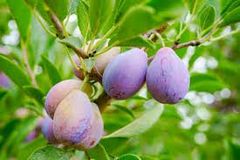
Prunus domestica
A small deciduous tree or large shrub, usually 4–8 m, carrying oval to round fruit with a waxy bloom and a single flattened stone. Hedgerows, field margins, scrub, railway banks and abandoned orchards, often self-seeded from planted stock or spreading by suckers into thickets.
Caution: Ripe flesh is safe raw or cooked, but unripe fruit is astringent and can upset the stomach.
View field guide entry →Cantharellus cibarius
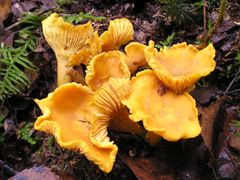
A firm, egg-yellow funnel with blunt, forking ridges running down onto a tapering stem rather than true gills. Mycorrhizal with broadleaves and conifers — oak, beech, birch and Scots pine — so it always pushes up from soil, moss or leaf litter, never from wood.
Caution: Cook thoroughly; raw or lightly cooked fruitbodies unsettle some stomachs.
View field guide entry →Rubus fruticosus
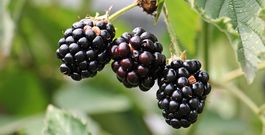
A scrambling, thorny shrub of the rose family that throws arching biennial canes over hedges, scrub and waste ground. Hedgerows, woodland edges and rides, scrub, railway banks, waste ground and neglected gardens, on almost any soil.
Caution: No part is toxic and the fruit needs no preparation, but pick above dog height and away from spray drift on arable field margins.
View field guide entry →Agaricus campestris
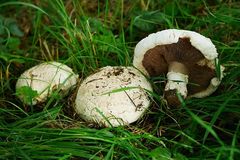
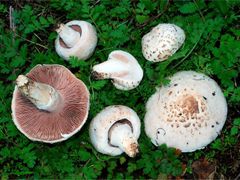
A white, dry-capped mushroom of open grassland, usually 3–10 cm across, domed then flattening, with a silky to faintly scaly surface. Saprotrophic in nutrient-rich short grassland — grazed pasture, meadows, lawns, playing fields and stabilised dunes — appearing in scattered troops or arcs a few days after rain.
Caution: Eat cooked and young; raw or in quantity it disagrees with some people.
View field guide entry →Ribes nigrum
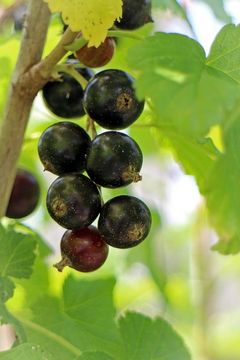
A deciduous shrub to about 1.5 m with upright, thornless stems and shallowly lobed, maple-like leaves that smell strongly resinous when crushed. Damp, fertile soils in wet woodland, alder and willow carr, fen edges, stream banks and hedgerows.
Caution: No part is toxic and the berries can be eaten raw, though they are sharply acid and better cooked.
View field guide entry →Agaricus arvensis
A stout white grassland mushroom with a cap 8–20 cm across, dry and silky, often splitting into pale scale-like patches as it expands. Saprotrophic, fruiting in unimproved pasture, meadows, lawns, verges and dune grassland, often where livestock have grazed and sometimes in arcs or rings.
View field guide entry →Rubus idaeus
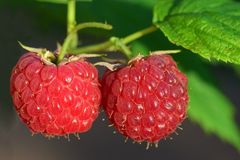
A slender, upright bramble with biennial canes, pinnate leaves whose undersides are white-felted, and soft red aggregate fruit that lifts free of its core when ripe, leaving a thimble-shaped hollow.
Caution: Fruit is edible raw and has no toxic lookalike in Britain — the other native Rubus fruits are edible too, so a mix-up within the genus carries little consequence.
View field guide entry →Prunus cerasifera
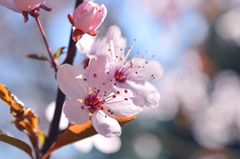
A small tree or large shrub, often the first blossom of the year: white five-petalled flowers open on green twigs in February or March, before or just as the leaves appear. Not native, but planted and naturalised in hedgerows, roadside verges, scrub, railway banks, parks and gardens.
Caution: The flesh is edible raw once soft; hard underripe fruit is sour and can be laxative in quantity.
View field guide entry →
At their peak in July
In the middle of their season and at their best right now.
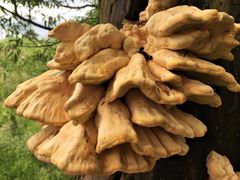
Laetiporus sulphureus
A bright sulphur-yellow to salmon-orange bracket that grows in overlapping fans and shelves from the trunks of living hardwoods, most often oak. Parasitic and then saprotrophic, causing a brown heart-rot inside standing hardwoods — oak most commonly, also sweet chestnut, willow, cherry and occasionally yew.
Caution: Always cook thoroughly; it is not eaten raw.
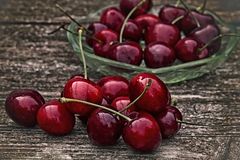
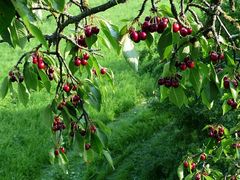
View field guide entry →Prunus
Cherries are small, round, and typically red or black fruit with a sweet or tart flavour, depending on the variety. In the UK, cherries are grown in orchards and gardens, often in the southern regions where the climate is warmer.
Caution: Cherries are generally safe to eat, but the pits should be avoided as they contain cyanogenic compounds.
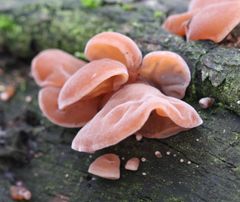
View field guide entry →Auricularia auricula-judae
A soft, rubbery bracket shaped like a cupped ear, usually 3-8cm across, tan to deep reddish-brown, with folds and veins across the smooth inner face and a fine velvety bloom on the outside.
Caution: Cook it thoroughly; raw or barely cooked it sits badly with some people.
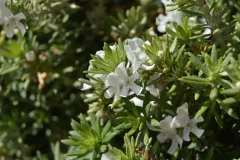
View field guide entry →Salvia rosmarinus
A dense evergreen shrub with woody, upright stems and stiff, needle-like leaves that are dark green above and pale grey-felted beneath, releasing a strong resinous, pine-and-camphor scent when crushed.
Caution: Safe as a culinary herb in ordinary cooking amounts; the concentrated essential oil is a different matter and is not for internal use.
View field guide entry →Pleurotus
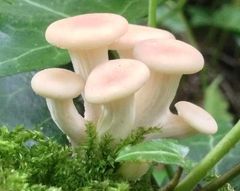
Good edible; decurrent gills; clustered, branched caps; mild aniseed-flour aroma; funnel-shaped cream to ochre caps
Caution: No known toxicity; edible; stems can be firm—caps preferred; ensure confident ID as other oyster mushrooms can look similar
View field guide entry →Amanita
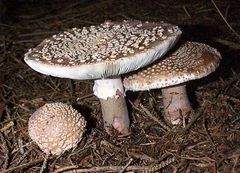
Cap: 5–15 cm across, convex to flat, with small white-to-brown or greyish scales and often variable hues—from pinkish to brown or silvery. Mycorrhizal with deciduous and coniferous trees (oak, beech, pine, fir), often found in poor, acidic soils in woodlands and forest edges.
Caution: Important: The Blusher is edible only when thoroughly cooked.
View field guide entry →Ribes uva-crispa
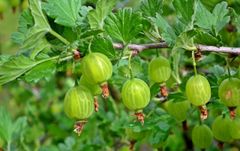
A low, spiny deciduous shrub, rarely over 1.5 m, with small palmately lobed leaves and translucent berries — green ripening to yellow-green, amber or dull red — marked with pale longitudinal veins.
Caution: The fruit carries no toxicity, though hard unripe berries are sharply acidic and eaten in quantity can upset the stomach; the leaves and stems are not eaten.
View field guide entry →Rumex acetosa
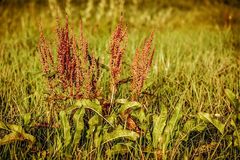
A slender grassland perennial with a basal rosette of arrow-shaped leaves, sharply sour from oxalic acid, and reddish flower spikes rising to knee height in early summer. Meadows, pastures, verges, woodland rides and upland grassland on neutral to acidic soils, from sea level to mountain ledges.
View field guide entry →
Last chance in July
The window is closing — these are largely done once the month turns.
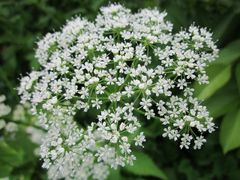
Aegopodium
Ground Elder is a perennial plant in the carrot family, known for its aggressive growth and spreading habit. Ground Elder thrives in shady, damp areas such as woodlands, hedgerows, and gardens, often forming dense colonies.
Caution: Ground Elder can be invasive, spreading rapidly via underground rhizomes and difficult to control once established.
View field guide entry →Prunus avium
A large, firm-fleshed sweet cherry: deep mahogany to near-black when ripe, heart-shaped, hanging singly or in pairs on long slender stalks among drooping, doubly toothed leaves. 'Bing' is a mid to late season cultivar of wild cherry with dark red flesh, a small free stone and a rich, low-acid flavour, eaten fresh rathe…
Caution: The flesh is a straightforward edible with no preparation needed.
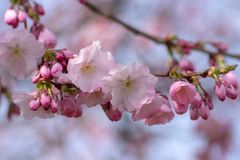
View field guide entry →Prunus subhirtella
A small ornamental cherry that flowers on bare wood in early spring, the pink semi-double blossom opening in stalked clusters before any leaves unfold. 'Accolade' is a garden hybrid grown for that display rather than for a crop; fruit sets sparsely if at all, and the small blackish cherries are bitter.
Caution: The flesh is not toxic, but the stones, leaves and twigs hold cyanogenic glycosides, so do not crush stones into a preserve or use the leaves as a tea.
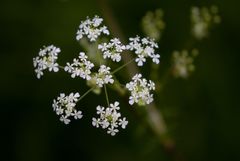
View field guide entry →Anthriscus sylvestris
A tall, hollow-stemmed umbellifer that whitens road verges and hedgebanks from late April, carrying flat-topped clusters of small white flowers above soft, fern-like foliage cut two or three times into narrow segments.
Caution: Not a plant to pick until you can name every white umbellifer in the hedge.
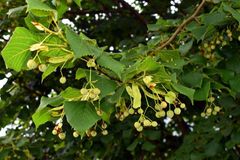
View field guide entry →Tilia europaea
A tall, broad-crowned tree reaching about 40 m, the hybrid between small-leaved and large-leaved lime and by far the commonest lime planted in Britain. Planted rather than genuinely wild: avenues, churchyards, parkland, town streets and old estate plantings on deep fertile soils throughout Britain and Ireland.
Caution: No toxicity is recorded for the leaves or flowers, and flower tea is normally made from fresh, freshly opened blossom rather than browned or wilted heads.
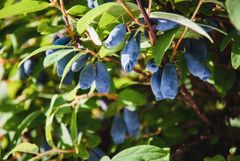
View field guide entry →Lonicera caerulea
A low, twiggy deciduous shrub with oval, softly downy leaves in opposite pairs and oblong blue-black berries carried in twos along the shoots, each under a heavy pale bloom.
Caution: Ripe fruit needs no preparation, though it is sharply acidic until fully soft and dark to the centre.
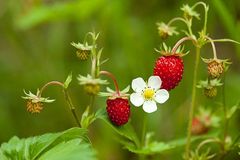
View field guide entry →Fragaria
Strawberries are small, red, sweet fruits with tiny seeds on their surface. Strawberries grow best in well-drained, slightly acidic soil in gardens or fields, thriving in sunny areas.
Caution: Strawberries are generally safe, but they can cause allergic reactions in sensitive individuals.
View field guide entry →
The buckets above are capped at the most-logged species. For everything in season this month, browse the full July list in the field guide →
What foragers actually logged in July
In July, foragers logged 3,066 finds — one of the busier months in the app. The species recorded most were Chicken of the woods (501), Wild Garlic (368), Ground Elder (306), Plums (293) and Chanterelle (214). Counts are aggregated across all foragers, with no location or personal detail.
Log your own finds
The calendar is built from what foragers record in the app. It's free, with no account needed to browse.

