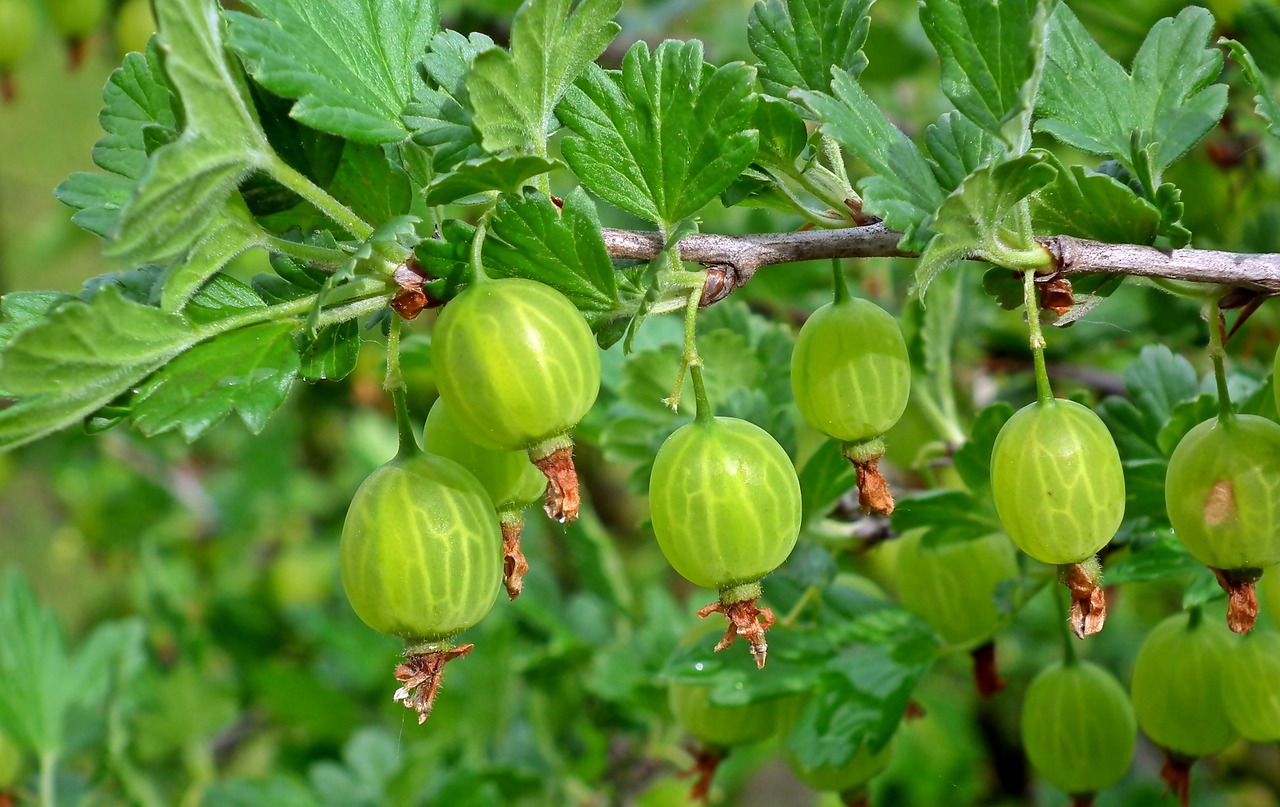
Gooseberries
Ribes uva-crispa
A low, spiny deciduous shrub, rarely over 1.5 m, with small palmately lobed leaves and translucent berries — green ripening to yellow-green, amber or dull red — marked with pale longitudinal veins. Long grown in Britain and widely naturalised from bird-sown seed in hedges and around old gardens. The sharp green fruit is picked for fools, pies, jams and vinegars; berries left on the bush soften and sweeten enough to eat raw.
Hedges, scrub, woodland edges, railway banks and the rough ground around old gardens and allotments, usually on damp, part-shaded, moderately fertile soil. Widespread across Britain and Ireland and thinning in the far north; most bushes are escapes rather than plantings.
The fruit carries no toxicity, though hard unripe berries are sharply acidic and eaten in quantity can upset the stomach; the leaves and stems are not eaten. The stems bear stout spines at almost every node and often bristles between them, so reach in slowly or wear gloves. Bushes on lane-side hedges may be sprayed or splashed by traffic.
Always use more than one reference to confirm a plant. You are responsible for what you choose to forage.
Spiny stems
Stout spines sit singly or in twos and threes at each leaf node, with fine bristles along the stem between nodes on many bushes. Blackcurrant and redcurrant are wholly unarmed, so a spiny Ribes in a British hedge is almost always this one.
Fruit arrangement
Berries hang singly, or in twos and threes, on short stalks straight from the nodes. Redcurrant and blackcurrant carry theirs in dangling strings of a dozen or more, which rules them out from a couple of metres away.
Berry surface
Skin is translucent with pale longitudinal veins showing through, often with scattered stiff hairs, and keeps a small dried flower remnant at the tip. Currants are opaque and smooth-skinned.
Leaves
Small, 2–5 cm, palmately three- to five-lobed with blunt teeth, dull green and slightly hairy. Crushing them gives no pungent scent, unlike the strong resinous smell of blackcurrant foliage.
Flowers
Small, bell-shaped and dull greenish-pink, hanging singly or in pairs from the nodes in spring. They are easy to walk past, so bushes are usually first noticed in leaf or fruit.
Updated 2026-08-07T20:52:31.115Z · Part of the shared Foragers Log catalogue · Fruit