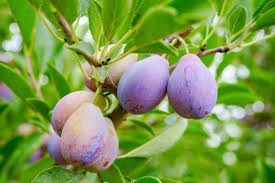
Plums
Prunus domestica
A small deciduous tree or large shrub, usually 4–8 m, carrying oval to round fruit with a waxy bloom and a single flattened stone. Colour runs from green and yellow through red to deep purple-black, and sweetness varies as much as colour. The species covers damsons, bullaces and gages as well as the familiar dessert and cooking plums, all long naturalised in British hedgerows and the remains of old orchards.
Hedgerows, field margins, scrub, railway banks and abandoned orchards, often self-seeded from planted stock or spreading by suckers into thickets. Widespread across lowland Britain and Ireland on deep, well-drained soil in full sun; scarcer at altitude and in the far north.
Ripe flesh is safe raw or cooked, but unripe fruit is astringent and can upset the stomach. The kernel inside the stone contains amygdalin and releases cyanide when chewed, so discard stones rather than crushing them into preserves or steeping them long-term in spirits. Windfalls draw wasps, and trees on verges may carry road spray.
Always use more than one reference to confirm a plant. You are responsible for what you choose to forage.
Fruit
Oval to round, 2–5 cm, with a shallow groove running from stalk to tip and a dusty bloom that rubs off under the thumb. The stone is flattened and ridged, not the near-spherical pip of a cherry.
Twigs and thorns
Branches are thornless or carry only occasional short, blunt spur shoots. Blackthorn, which grows in the same hedges and can bear similar dark fruit, ends its sideshoots in hard, sharp spines.
Leaves
Dull mid-green, oval to obovate, 4–10 cm, finely toothed and softly hairy on the underside, often folded upwards along the midrib. Distinctly broader and duller than the small, narrow leaf of blackthorn.
Flowers
White, five-petalled, 1.5–2.5 cm across, opening in March and April with or just after the first leaves. If a hedgerow tree is in full white flower on bare wood before any leaf shows, it is blackthorn rather than a plum.
Updated 2026-08-08T12:03:29.166Z · Part of the shared Foragers Log catalogue · Fruit