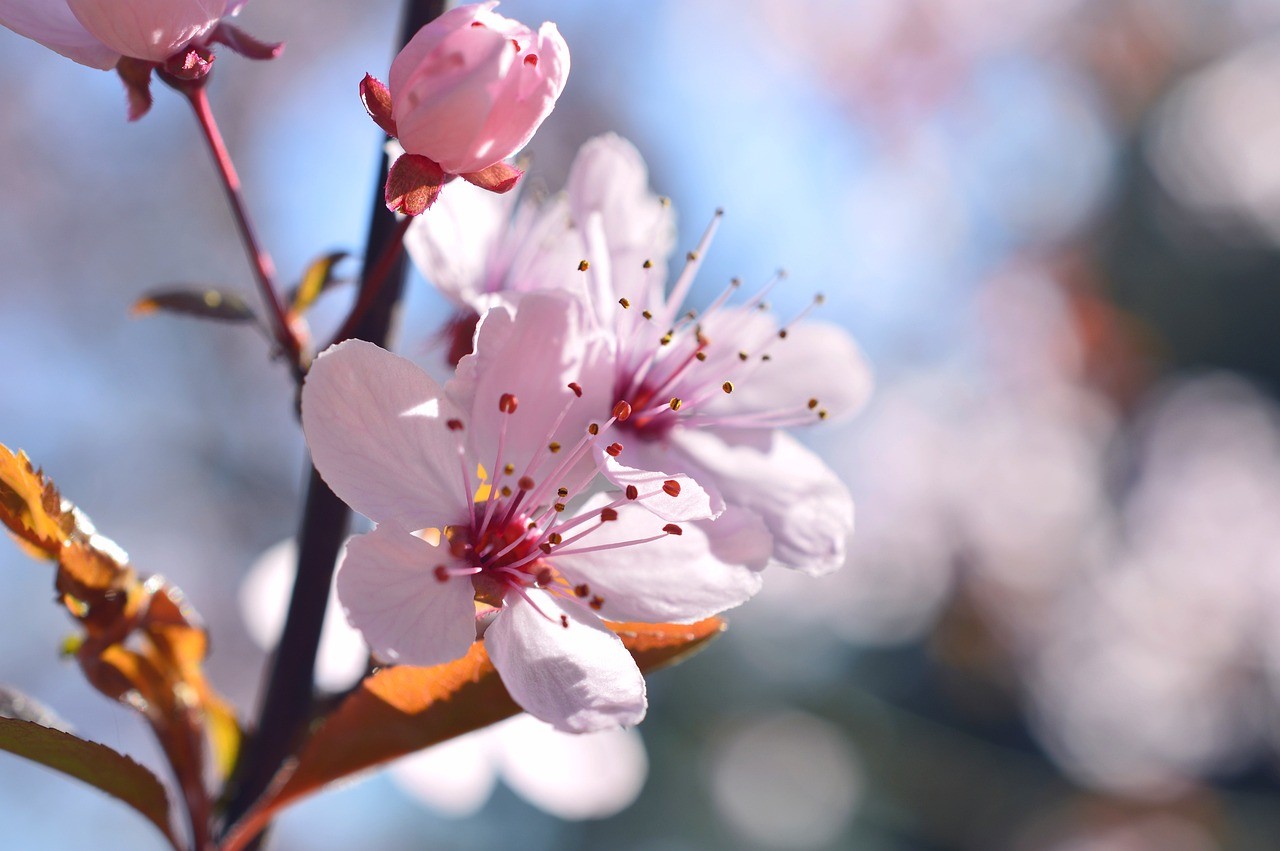
Cherry plum
Prunus cerasifera
A small tree or large shrub, often the first blossom of the year: white five-petalled flowers open on green twigs in February or March, before or just as the leaves appear. The fruit is a round, thin-skinned plum 2–3cm across, ripening yellow, orange or red, sweet with a sharp skin. Planted widely in hedges and streets, including purple-leaved forms, and thoroughly naturalised. Good raw when fully soft, and reliable in jams, chutneys and fruit leathers.
Not native, but planted and naturalised in hedgerows, roadside verges, scrub, railway banks, parks and gardens. Widespread across lowland Britain and Ireland and commonest in southern and eastern England, usually near habitation rather than in old woodland.
The flesh is edible raw once soft; hard underripe fruit is sour and can be laxative in quantity. As with other Prunus, the stones contain cyanogenic compounds, so do not crack and eat the kernels or blend whole fruit with stones in. Trees are often on verges and street corners, so expect traffic dust and possible spray, and wash fruit well.
Always use more than one reference to confirm a plant. You are responsible for what you choose to forage.
Flowering time
White blossom opens in February or early March, on bare or barely leafing green twigs, making it the earliest flowering Prunus in most UK hedges. Blackthorn in the same hedge usually follows several weeks later on dark, spiny wood.
Twigs and spines
Young twigs are slender, glossy and green or reddish, and the tree is essentially unarmed, with at most a few short stiff shoots. Any hedgerow plum-type shrub bristling with sharp spines is not this species.
Fruit shape and stalk
Fruit is almost spherical, 2–3cm across, yellow through orange to deep red, thin skinned and hanging on a slender stalk. Garden and hedgerow plums of Prunus domestica are larger, more oval and usually blue, purple or green.
Stone
The stone is rounded rather than flattened and clings to the flesh, so the fruit will not halve cleanly. Useful when a purple-leaved street tree has dropped fruit you want to place.
Leaves
Leaves are small, oval to elliptical, finely toothed and bright glossy green, with fine hairs along the midrib beneath. Ornamental forms such as 'Nigra' and 'Pissardii' have the same shape in deep purple, and their fruit is edible in the same way.
Updated 2026-08-08T12:03:10.291Z · Part of the shared Foragers Log catalogue · Fruit