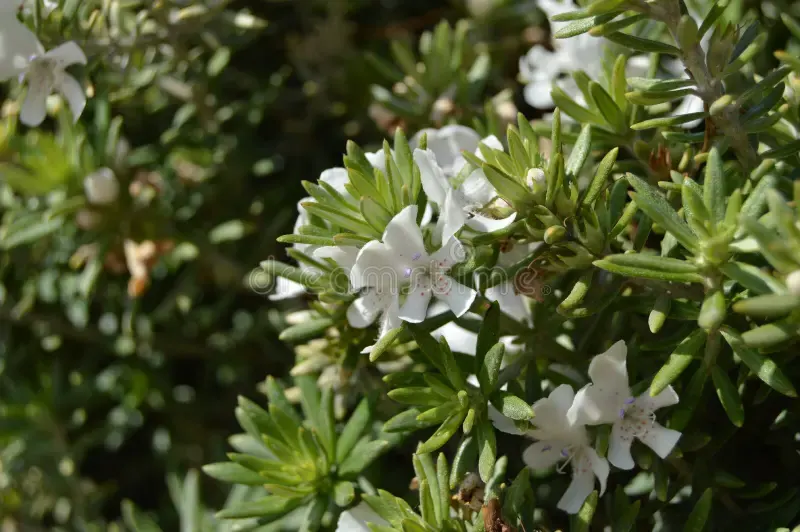
Rosemary
Salvia rosmarinus
A dense evergreen shrub with woody, upright stems and stiff, needle-like leaves that are dark green above and pale grey-felted beneath, releasing a strong resinous, pine-and-camphor scent when crushed. Small two-lipped flowers in pale blue to violet sit in the leaf axils, mostly in spring but often again in mild autumns. Long placed in its own genus as Rosmarinus officinalis, it was moved to Salvia on molecular evidence in 2017; both names remain in circulation, and the plant in the kitchen is the same either way. Used for roast meats, potatoes, bread and infused oils.
Native to the dry, rocky hillsides and scrub of the Mediterranean, and in Britain and Ireland almost always a garden or allotment plant. It persists and occasionally naturalises on free-draining sunny ground — old walls, banks and coastal gardens in the south — but dislikes wet winter soil and does not spread far.
Safe as a culinary herb in ordinary cooking amounts; the concentrated essential oil is a different matter and is not for internal use. Bog rosemary (Andromeda polifolia) has similarly narrow, leathery, down-curled leaves but grows on wet acid bog and peat rather than dry ground, has no aromatic scent when crushed, and is toxic. Woody sprigs are tough enough to injure the mouth and are usually lifted out before serving.
Always use more than one reference to confirm a plant. You are responsible for what you choose to forage.
Growth habit
A woody shrub rather than a soft-stemmed herb, upright or sprawling to about 1.5m, holding its leaves through winter. The oldest stems are grey and bark-covered, so a plant recognised in July is still findable in January.
Leaves
Narrow and needle-like, 2–4cm long, leathery, with the margins rolled under so the leaf looks almost cylindrical. Dark green above, distinctly pale and felted beneath — turning a leaf over is the quickest check against the flat, soft leaves of most other culinary shrubs.
Flowers
Pale blue to violet, occasionally white or pink, two-lipped and about 1cm across, borne in short clusters along the stems in the leaf axils rather than in the dense terminal spikes of lavender.
Crush test
A pinched leaf gives an immediate strong resinous scent of pine and camphor that stays on the fingers. A narrow-leaved shrub with no scent at all when crushed is not rosemary and should be left alone.
Updated 2026-08-07T20:46:08.938Z · Part of the shared Foragers Log catalogue · Herb