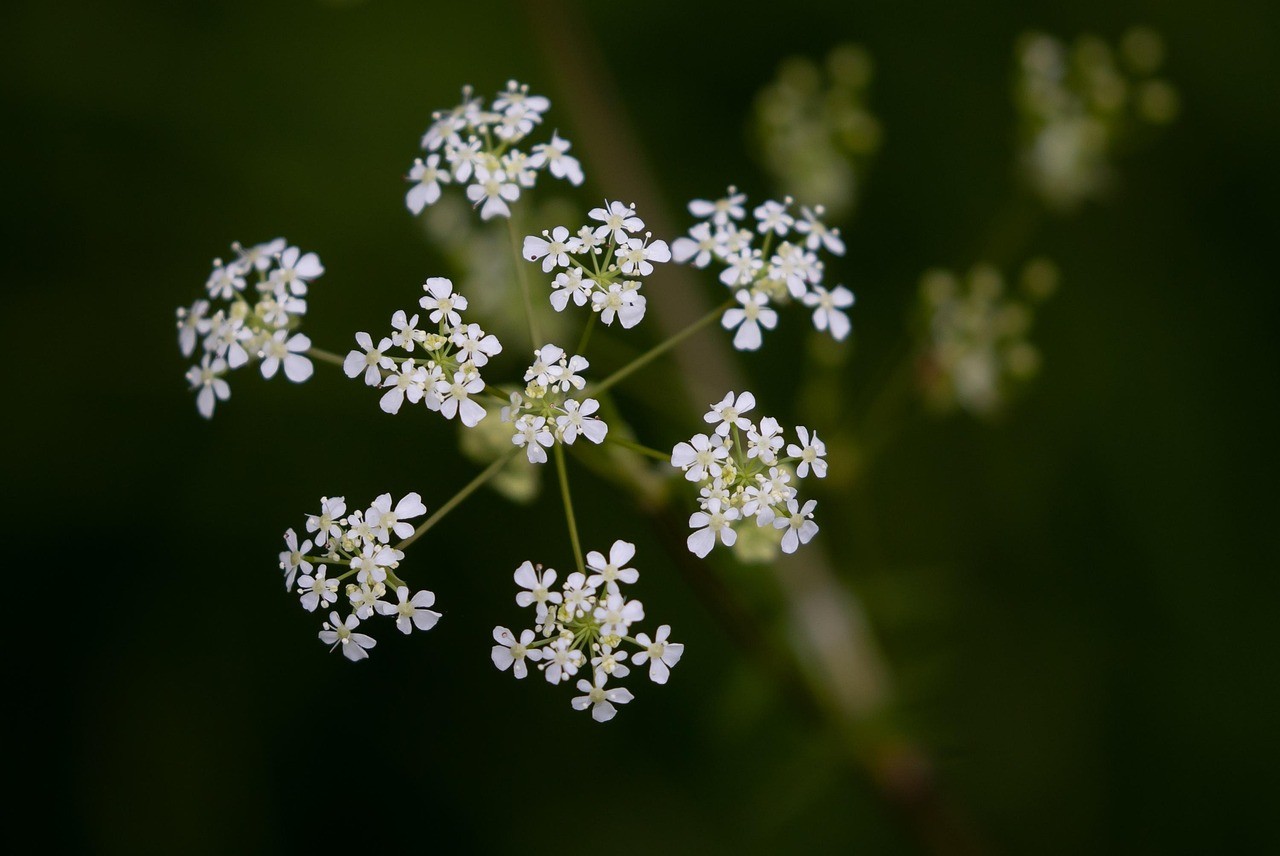
Cow parsley
Anthriscus sylvestris
A tall, hollow-stemmed umbellifer that whitens road verges and hedgebanks from late April, carrying flat-topped clusters of small white flowers above soft, fern-like foliage cut two or three times into narrow segments. The stems are ridged and plain green, and crushed leaves smell faintly of parsley with a hint of aniseed. Young leaves are used sparingly as a herb, though the family includes Britain's most poisonous plants, so certainty comes before picking.
Hedgebanks, road verges, woodland edges, riverbanks and rough grassland on damp, fertile soil, often in dense continuous stands. Abundant and widespread across Britain and Ireland, thinning only on very poor or strongly acidic ground.
Not a plant to pick until you can name every white umbellifer in the hedge. Hemlock water-dropwort (Oenanthe crocata) is deadly and grows in wet ground, with broader, blunt-toothed celery-like leaflets rather than finely cut fern-like ones. Hemlock (Conium maculatum) is deadly and has purple-blotched stems and a rank mousy smell when crushed, not a parsley scent. Rough chervil (Chaerophyllum temulum) is toxic, flowers later, and has bristly, purple-spotted, solid stems. Young giant hogweed (Heracleum mantegazzianum) has coarsely lobed leaves and sap that blisters skin in sunlight. This plant's own sap can cause mild photosensitivity in a few people, and verge-side stands carry traffic pollution.
Always use more than one reference to confirm a plant. You are responsible for what you choose to forage.
Overall form and season
The first common white umbellifer of the year, standing 60–150 cm and flowering from late April into June. It is well over before hogweed and giant hogweed reach full height, so a large white umbel in early May in a hedgebank is usually this rather than a summer species.
Stem
Hollow, distinctly ridged or grooved, hairless above and plain green, sometimes flushed dull purple at the very base. There are none of the sharp purple blotches of hemlock (Conium maculatum), and no bristly hairs and solid pith as in rough chervil (Chaerophyllum temulum).
Leaves
Two to three times pinnate, soft and fern-like, the final divisions narrow and pointed, held on a clear stalk that sheathes the stem at its base. Broad, blunt-toothed leaflets like flat-leaf celery point instead to hemlock water-dropwort (Oenanthe crocata).
Flower heads
Flat-topped umbels roughly 2–6 cm across of small white flowers, typically with no bracts at the base of the main umbel but small narrow bracteoles beneath each secondary cluster. Look at the base of the umbel before the petals.
Smell of crushed leaf
Faintly sweet, like parsley with a trace of aniseed. Anything rank, mousy, musty or strongly of parsnip means you are not holding this plant — stop, put it down and wash your hands.
Updated 2026-08-07T20:46:15.672Z · Part of the shared Foragers Log catalogue · Herb