Raspberry
Rubus idaeus
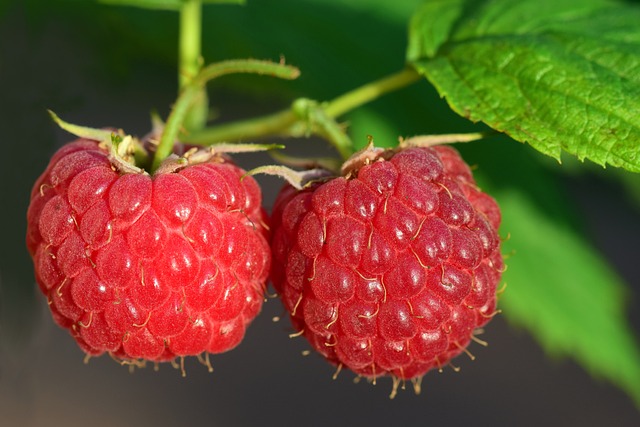
A slender, upright bramble with biennial canes, pinnate leaves whose undersides are white-felted, and soft red aggregate fruit that lifts free of its core when ripe, leaving a thimble-shaped hollow. Wild plants crop more lightly than garden stock but the fruit is sweeter and more aromatic. Eaten raw, cooked into preserves, or fermented; the leaves have a long history of use as a tea.
Native across Britain and Ireland on well-drained, slightly acid soils: open woodland and clearings, heathy banks, upland scrub, railway sides and old quarry ground. Also widely naturalised from gardens near habitation.
Fruit is edible raw and has no toxic lookalike in Britain — the other native Rubus fruits are edible too, so a mix-up within the genus carries little consequence. The canes bear fine, straight prickles that snap off in the skin. Avoid sprayed field margins and heavily trafficked verges. Raspberry-leaf tea is a traditional pregnancy remedy; anyone pregnant may wish to take advice before drinking it regularly.
Always use more than one reference to confirm a plant. You are responsible for what you choose to forage.
Fruit and core
A ripe berry slides off a pale conical receptacle and is hollow inside, like a thimble. Blackberries and dewberries keep their core, so the hollow settles the identification even from a single fruit.
Canes
Biennial and near-upright, spreading by underground suckers into dense thickets rather than arching over and rooting at the tip. First-year canes are whitish-bloomed and armed with slender, straight prickles, not the stout hooked thorns of a bramble.
Leaves
Pinnate with three to five toothed leaflets, the terminal one stalked. The underside is white-felted, so a whole thicket flickers pale when wind turns the foliage — visible from several metres away.
Flowers
Small, drooping and white, with narrow petals no longer than the sepals, from late May into July. Far less showy than bramble flowers, which have broad, flat, often pink-flushed petals.
Updated 2026-08-08T12:03:08.449Z · Part of the shared Foragers Log catalogue · Fruit