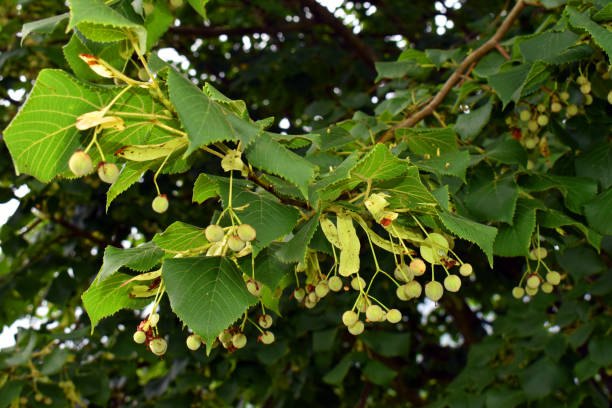
European linden
Tilia europaea
A tall, broad-crowned tree reaching about 40 m, the hybrid between small-leaved and large-leaved lime and by far the commonest lime planted in Britain. The leaves are heart-shaped with an uneven base, and in early summer clusters of scented creamy-yellow flowers hang beneath pale strap-shaped bracts. Young leaves are eaten raw in salads and the flowers dried for tea.
Planted rather than genuinely wild: avenues, churchyards, parkland, town streets and old estate plantings on deep fertile soils throughout Britain and Ireland. Self-sown seedlings occur, and the hybrid also arises spontaneously where both parents grow together.
No toxicity is recorded for the leaves or flowers, and flower tea is normally made from fresh, freshly opened blossom rather than browned or wilted heads. Most limes in Britain stand along streets and in parks, so weigh up traffic dust, spraying and dog traffic before picking. From midsummer aphids coat the foliage in sticky honeydew and sooty mould; pick earlier in the season or from cleaner trees.
Always use more than one reference to confirm a plant. You are responsible for what you choose to forage.
Habit and trunk base
A big domed tree, often in a row or avenue, with a dense burry mass of twiggy sprouts around the base of the trunk. Neither parent produces that thicket of basal shoots so reliably, which is the first thing to look for from a distance.
Leaf underside
Leaves 6–10 cm, heart-shaped and lopsided at the base, dull dark green above and paler beneath with small tufts of whitish or buff hairs in the vein angles. Small-leaved lime has rusty-brown tufts; large-leaved lime is softly hairy all over the underside rather than just in the angles.
Flower clusters
Four to ten pendulous creamy-yellow flowers per cluster, hanging below a narrow pale bract and strongly scented on a warm evening. Small-leaved lime holds its clusters outwards or upwards; large-leaved lime hangs three or fewer per cluster.
Fruit
A small downy nutlet, faintly ribbed and intermediate between the parents — not the thin unribbed shell of small-leaved lime nor the strongly ribbed, woody fruit of large-leaved lime. Worth checking in autumn if the tree's identity matters.
Sticky leaves in summer
By July the foliage and anything parked beneath is often glazed with aphid honeydew and blackened by sooty mould. It is harmless but makes flowers unpleasant to dry, so it decides which tree you pick from rather than whether the species is right.
Updated 2026-08-08T06:53:07.972Z · Part of the shared Foragers Log catalogue · Other