Blusher
Amanita
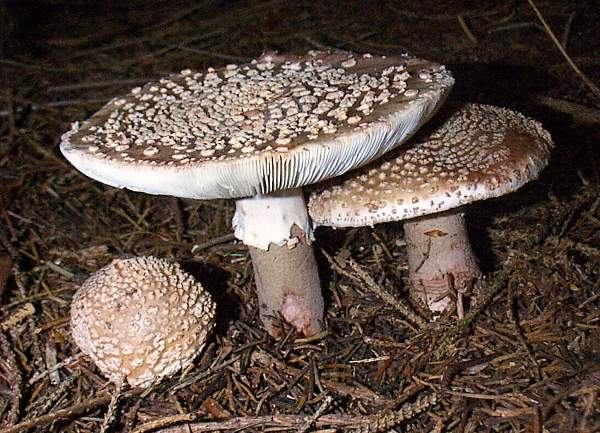
Cap: 5–15 cm across, convex to flat, with small white-to-brown or greyish scales and often variable hues—from pinkish to brown or silvery. Damaged flesh blushing pink is a key ID feature. Gills: White, crowded, free from stem; develop pinkish or reddish spots when bruised. Stem: 5–15 cm long, white or with cap-colored tints; has a striate (grooved) ring and often a swollen base without a visible volva. Bruises pink when cut. Spore Print: White; spores are ovate, ~8 x 5 µm. Odor/Taste: Mild, not distinctive. Raw flesh has a faint acrid aftertaste; no notable smell.
Mycorrhizal with deciduous and coniferous trees (oak, beech, pine, fir), often found in poor, acidic soils in woodlands and forest edges. Common in temperate Europe, Asia, and North America.
Important: The Blusher is edible only when thoroughly cooked. Raw or undercooked, it contains hemolytic toxins causing anemia. Cooking neutralizes these toxins. Lookalike Risk: Easily confused with the deadly Amanita pantherina (Panther Cap), which does not blush and lacks a striate ring. Vigilant identification is essential.
Updated 2025-08-26T13:45:20.670Z · Added 2025-08-22T08:54:01.806Z
Part of the shared Foragers Log catalogue · Fungus