Horse Mushroom
Agaricus arvensis
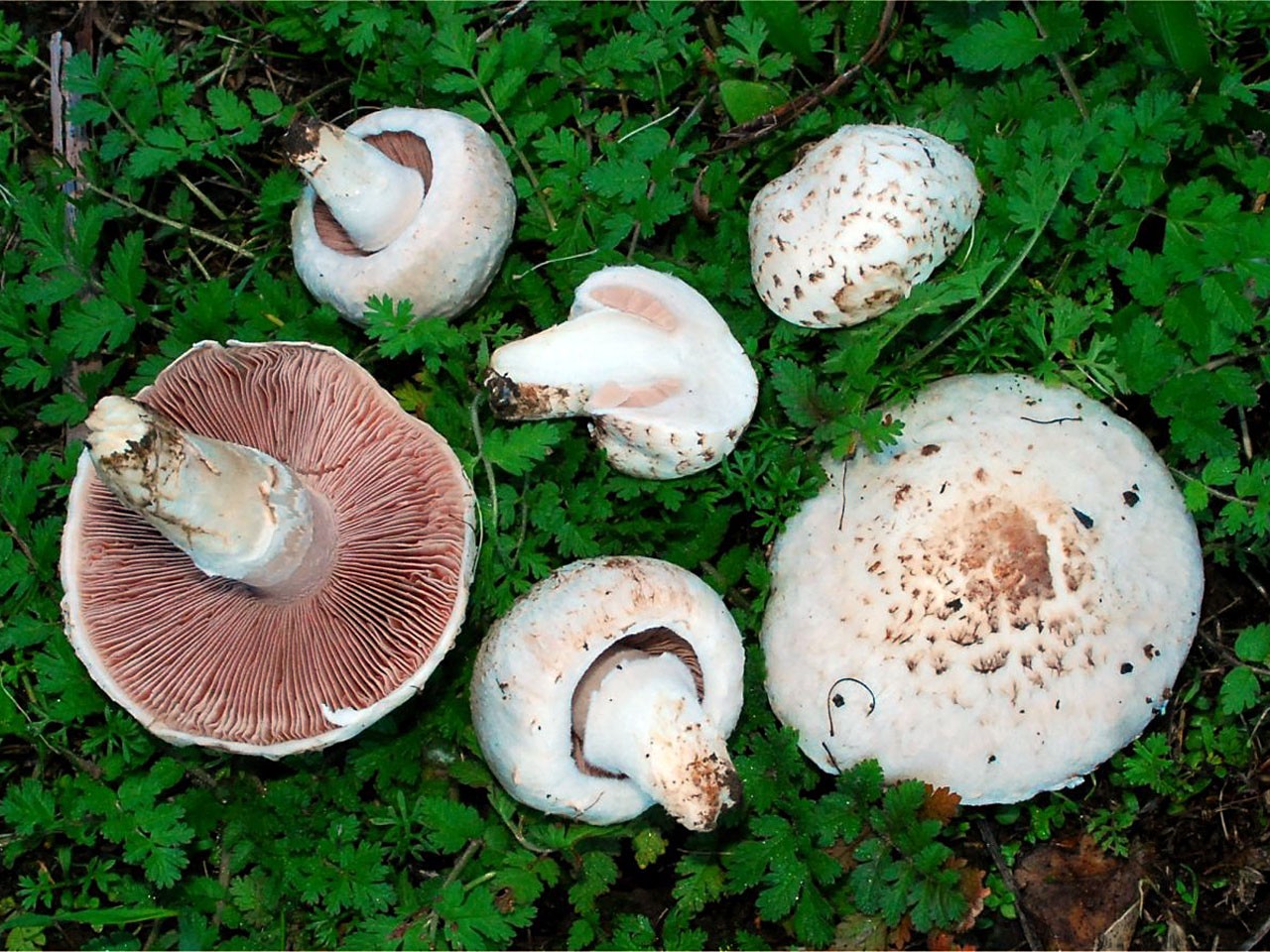
A stout white grassland mushroom with a cap 8–20 cm across, dry and silky, often splitting into pale scale-like patches as it expands. The gills begin greyish-pink, then darken through cocoa-brown to almost black, and the crushed flesh smells of aniseed or marzipan. One of the largest of the field mushrooms and a well-regarded edible, best taken young and cooked; older caps soften and are usually full of insect larvae.
Saprotrophic, fruiting in unimproved pasture, meadows, lawns, verges and dune grassland, often where livestock have grazed and sometimes in arcs or rings. Widespread across Britain and Ireland, occasionally at grassy woodland edges and under conifers.
Eaten cooked and generally well tolerated, though large Agaricus species disagree with some people and grassland fungi from verges or heavily manured ground are better left. Destroying Angel (Amanita virosa) grows in grass near trees and keeps pure white gills and a sac-like bag at the stem base, where this species' gills turn pink then chocolate-brown above a ringed, volva-less stem. Death Cap (Amanita phalloides) buttons on woodland-edge grass are also whitish but likewise have white gills and a bagged base.
Always use more than one reference to confirm a plant. You are responsible for what you choose to forage.
Cap
Creamy white, 8–20 cm across, at first hemispherical then flattening, dry and faintly silky. In dry weather the surface breaks into large flat scale-like patches, which is normal for this species rather than a sign of a different one.
Gills
Free from the stem, pale greyish-pink when young — never the bright clean pink of a young Field Mushroom — then cocoa-brown and finally almost black. Gills that stay pure white at every age indicate a white Amanita, not this.
Stem and ring
Stout and white, with a large drooping ring whose underside splits into radiating cogwheel-like segments. The base is clubbed but sits directly in the soil with no membranous sac around it.
Smell
Crushed flesh smells of aniseed or marzipan, strongest at the stem base. A phenolic or inky smell instead means the specimen is not this mushroom and should be discarded.
Bruising
Cut or handled flesh may slowly take on a dull yellow-ochre tint, especially in the stem base. A rapid, vivid chrome-yellow flush within seconds is a different species and not one to eat.
Updated 2026-08-08T12:03:14.535Z · Added 2025-08-22T07:30:58.421Z
Part of the shared Foragers Log catalogue · Fungus