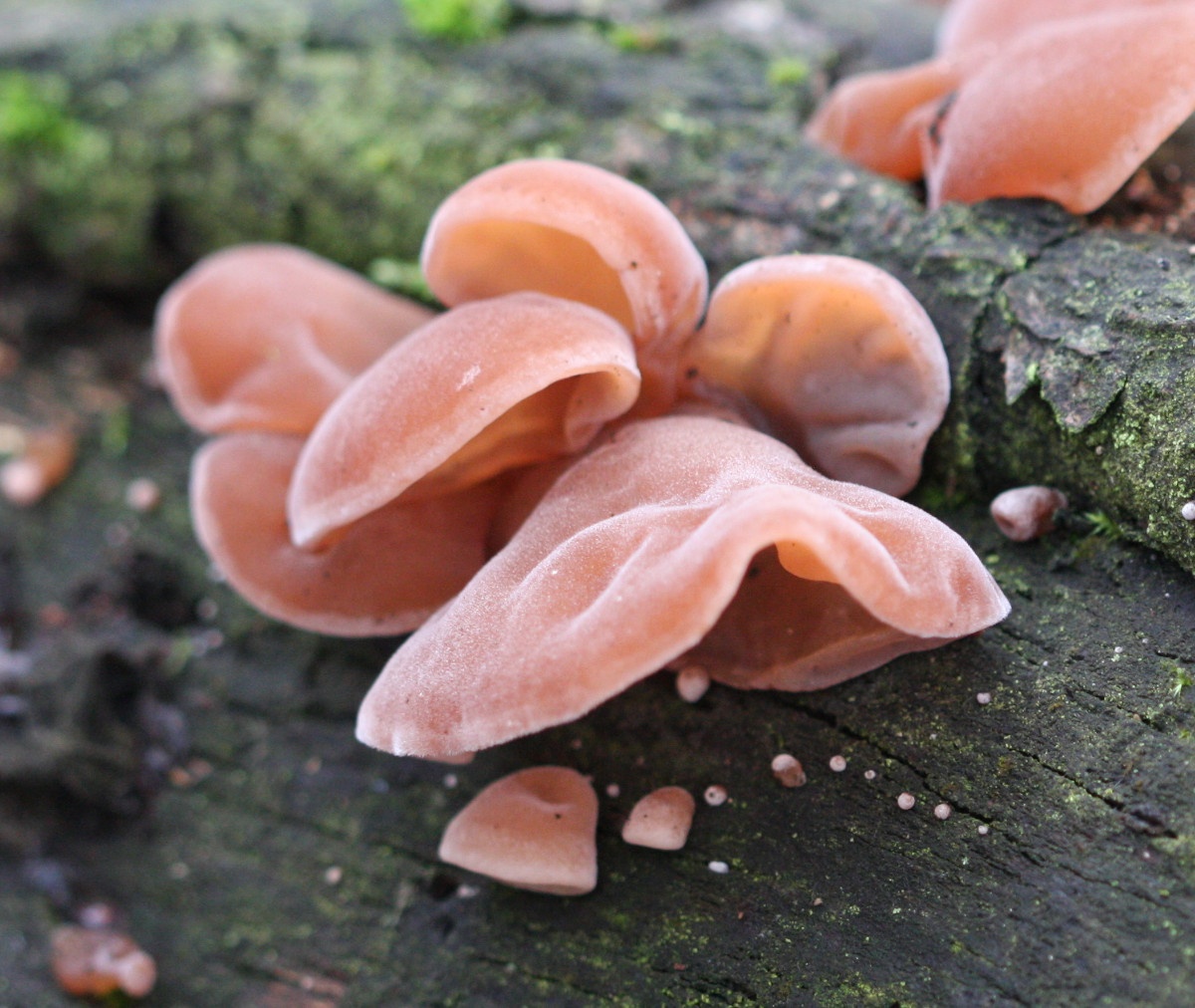
Jelly ear fungus
Auricularia auricula-judae
A soft, rubbery bracket shaped like a cupped ear, usually 3-8cm across, tan to deep reddish-brown, with folds and veins across the smooth inner face and a fine velvety bloom on the outside. It grows in tiers on dead and dying elder, holds its shape and slight crunch when cooked, and is used in soups, broths and stir-fries.
Saprotrophic, and weakly parasitic on ailing wood, overwhelmingly on elder (Sambucus nigra) but also beech, sycamore, ash and spindle. Common throughout Britain and Ireland in hedgerows, damp woodland edges and scrub, on standing dead branches as often as on fallen wood.
Cook it thoroughly; raw or barely cooked it sits badly with some people. The other gelatinous fungi found on British deadwood are harmless, so the consequences of a mistake here are slight. Auricularia species are reported to slow blood clotting, so anyone taking anticoagulants may wish to take advice before eating it in quantity. Avoid roadside elder.
Always use more than one reference to confirm a plant. You are responsible for what you choose to forage.
Shape and growth habit
An ear- or cup-shaped lobe 3-8cm across, attached to the wood at a narrow point and often growing in overlapping tiers along a branch. The outline is irregular and folded rather than circular.
Texture
Gelatinous but firm, with the give of soft rubber; it springs back when pressed. In dry weather it shrinks to a hard, dark, papery flake on the branch and swells back to full size after rain, so a shrivelled specimen is not necessarily an old one.
Two distinct surfaces
The inner, spore-bearing face is smooth, shiny and purplish- to reddish-brown, raised into vein-like wrinkles. The outer face is matt, paler greyish-brown and finely velvety, minutely hairy under a hand lens. This two-sided structure separates it from the brain-like jelly fungi, which look the same all over.
Host wood
Nearly always elder in Britain, on dead or dying branches of a living shrub as often as on fallen wood. Other broadleaves are used, but elder in a hedgerow is the first place to look.
Updated 2026-08-08T06:52:50.791Z · Part of the shared Foragers Log catalogue · Fungus