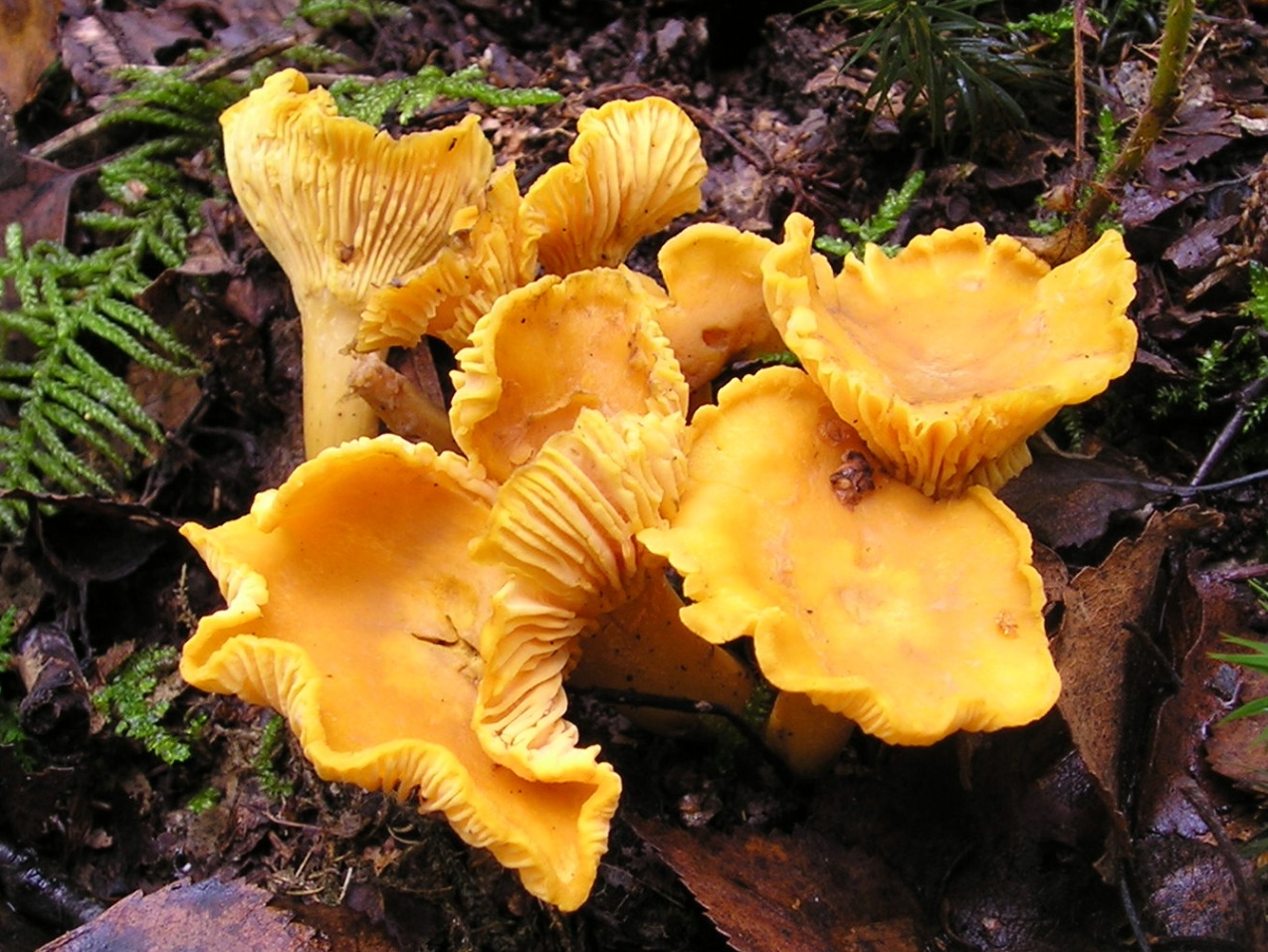
Chanterelle
Cantharellus cibarius
A firm, egg-yellow funnel with blunt, forking ridges running down onto a tapering stem rather than true gills. The flesh is white and thick, tearing in strings rather than snapping, and fresh fruitbodies carry a faint apricot smell. One of the most sought-after wild edibles in Britain, holding its texture well in a hot pan.
Mycorrhizal with broadleaves and conifers — oak, beech, birch and Scots pine — so it always pushes up from soil, moss or leaf litter, never from wood. Widespread on acidic, well-drained banks and woodland edges across Britain and Ireland, commonest in Scottish pinewoods.
Cook thoroughly; raw or lightly cooked fruitbodies unsettle some stomachs. Jack O'Lantern (Omphalotus illudens) is toxic and grows in dense clumps on wood or buried roots, with thin, crowded true gills instead of the blunt forking ridges seen here. Collecting is restricted or banned in some places, including the New Forest, so check local rules.
Always use more than one reference to confirm a plant. You are responsible for what you choose to forage.
Blunt ridges running down the stem
Turn it over. The underside carries shallow, blunt, forking wrinkles that look like folds in the flesh rather than separate blades, and they run continuously down onto the stem with no clear join. Try to catch one with a fingernail and it will not lift or tear. This is the decisive test: thin crowded blades that stand proud and nick cleanly are a different mushroom.
Egg-yellow throughout, trumpet-shaped
3–10cm across, evenly golden or apricot-yellow over cap, ridges and stem alike, with no browner centre. Convex at first, then spreading into a shallow irregular funnel with a wavy, lobed, inrolled margin. The surface is smooth and slightly greasy rather than felty.
Thick white flesh that tears in strings
Pull the cap apart rather than cutting it. The flesh is firm, several millimetres thick, white or very pale cream inside despite the yellow exterior, and it separates into fibrous strands like string cheese. Thin soft flesh coloured orange right through does not belong here.
Smells of apricots
Hold a few in a closed hand for a moment, then smell. There is a distinct sweet fruity note, closest to dried apricot, strongest in fresh specimens and in a full basket. A mushroom with no smell at all is worth a second look at the ridges.
From soil under trees, in troops
Comes up singly or in loose scattered groups directly from soil, moss or litter, always in the company of living trees. Fruiting on a stump, a fallen branch or a deep conifer needle bed points elsewhere.
Pale ochre spore deposit
Left face-down on white paper overnight, a mature cap drops a creamy to pale ochre-yellow print. A clearly white print points away from this species.
Solid, unhollowed stem
Cut lengthways the stem is filled with white flesh right through. Trumpet Chanterelle (Craterellus tubaeformis) has a hollow, often flattened stem and a brownish cap with greyish ridges.
Wavy, inrolled cap margin
The cap starts flat with an inrolled edge and becomes an irregular, lobed funnel with age. The surface is matt and faintly bloomed, never scaly or zoned in darker rings.
Updated 2026-08-08T12:03:16.775Z · Added 2025-08-24T12:30:45.425Z
Part of the shared Foragers Log catalogue · Fungus