Honeyberry
Lonicera caerulea
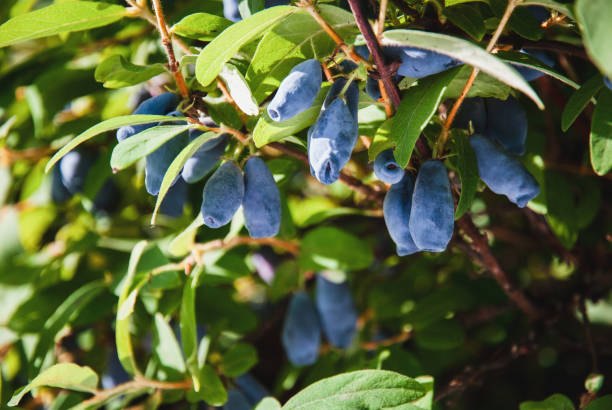
A low, twiggy deciduous shrub with oval, softly downy leaves in opposite pairs and oblong blue-black berries carried in twos along the shoots, each under a heavy pale bloom. The fruit is the earliest soft fruit of the British year, tasting somewhere between blueberry and blackcurrant and sharply acidic until fully soft. Grown in gardens and on smallholdings rather than found wild here, and often sold as haskap.
Native to cool northern latitudes across Siberia, northern Japan and northern Europe, where it grows in damp boreal woodland, bog margins and streamsides. In Britain and Ireland it occurs only as a planted garden, allotment and smallholding shrub, tolerant of exposure and cold.
Ripe fruit needs no preparation, though it is sharply acidic until fully soft and dark to the centre. Other honeysuckle berries are not edible: common honeysuckle (Lonicera periclymenum) carries red berries in tight terminal clusters, and fly honeysuckle (Lonicera xylosteum) paired red berries on downy twigs. Neither is ever blue-black beneath a waxy bloom, and both cause vomiting and stomach pain.
Always use more than one reference to confirm a plant. You are responsible for what you choose to forage.
Berries
Oblong to barrel-shaped, 1–2cm long, blue-black under a dense grey bloom, usually borne in pairs from the leaf axils. The elongated, often puckered shape and the paired arrangement separate them from the round, crown-tipped berries of a blueberry bush.
Leaves and shoots
Leaves in opposite pairs, oval, dull green and softly hairy, on slender shoots with pale shredding bark. Opposite leaves rule out the alternate-leaved Vaccinium and Ribes bushes that the fruit otherwise resembles.
Flowers
Small, pale creamy-yellow tubular flowers in pairs, opening very early in spring, often February to April, before most garden fruit is in leaf. Not the long trumpet flowers of a climbing honeysuckle.
Ripeness test
Cut a berry across: green or pale flesh means it will still be mouth-puckering however blue the skin looks. Fully ripe fruit is purple-red to the core and comes away without pulling.
Habit
A dense, rounded bush usually 1–1.5m tall and wide, never climbing or twining. Any honeysuckle scrambling through a hedge is a different species and its berries should be left alone.
Updated 2026-08-08T11:01:38.766Z · Part of the shared Foragers Log catalogue · Fruit