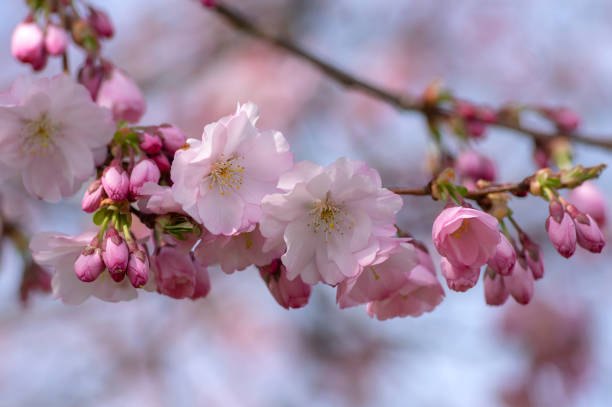
Accolade flowering cherry
Prunus subhirtella
A small ornamental cherry that flowers on bare wood in early spring, the pink semi-double blossom opening in stalked clusters before any leaves unfold. 'Accolade' is a garden hybrid grown for that display rather than for a crop; fruit sets sparsely if at all, and the small blackish cherries are bitter. The blossom is the part worth picking, used for syrups, sugars and salted preserves.
Not a wild plant in Britain and Ireland. Planted as an amenity tree in parks, on street verges, in churchyards and larger gardens, usually grafted on a clear stem. It does not naturalise, so a cherry found in woodland is far more likely to be a native species.
The flesh is not toxic, but the stones, leaves and twigs hold cyanogenic glycosides, so do not crush stones into a preserve or use the leaves as a tea. Street and park trees are among the most likely to have been sprayed or to carry traffic dust, and blossom is picked whole, so wash it before use.
Always use more than one reference to confirm a plant. You are responsible for what you choose to forage.
Flowers
Clear pink, semi-double flowers about 3–4 cm across, hanging in short-stalked clusters along bare twigs, deeper in bud than when fully open. Wild cherry (Prunus avium) flowers are white and single, and bird cherry (Prunus padus) carries its flowers in long spikes with the leaves already out.
Growth habit
A small tree of 6–8 m with spreading, slightly arching branches, almost always grafted on a straight clear stem at about head height — the giveaway that it is a planted ornamental rather than a self-sown native cherry.
Bark
Smooth, glossy grey-brown with distinct horizontal bands of raised lenticels, peeling in thin horizontal strips on older trunks. Typical cherry bark, and the first thing to check from a distance when the tree is out of flower.
Leaves and fruit
Leaves appear after the flowers, ovate with a drawn-out tip and sharp double teeth, bronze-tinged when young and turning orange-red in autumn. Fruit, when any forms, is a scatter of pea-sized dark red to black cherries, bitter and usually taken by birds.
Updated 2026-08-08T12:03:26.291Z · Part of the shared Foragers Log catalogue · Other