Blackcurrant
Ribes nigrum
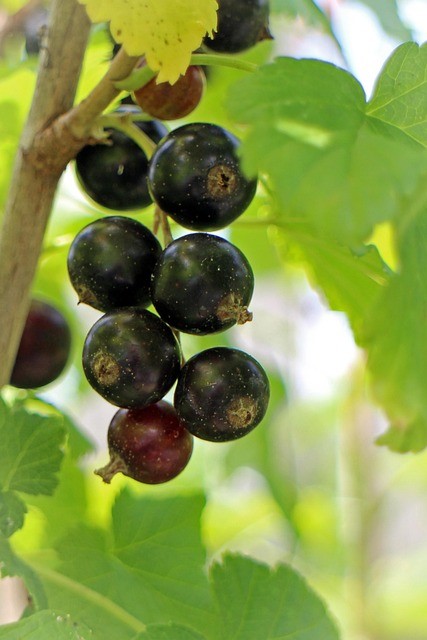
A deciduous shrub to about 1.5 m with upright, thornless stems and shallowly lobed, maple-like leaves that smell strongly resinous when crushed. The matt black berries hang in short drooping clusters, each fruit tipped with the shrivelled remains of the flower. Very sharp and aromatic raw, they are usually cooked into cordials, jams and jellies, and the leaves are traditionally infused as a tea.
Damp, fertile soils in wet woodland, alder and willow carr, fen edges, stream banks and hedgerows. Long cultivated and now widely naturalised across Britain and Ireland from garden escapes and bird-sown seed.
No part is toxic and the berries can be eaten raw, though they are sharply acid and better cooked. Use scent as the check: crush a leaf, and if there is no strong resinous blackcurrant smell, leave the fruit alone, since several unrelated shrubs carry small black berries. Bushes on verges and lay-bys collect traffic dirt and spray drift.
Always use more than one reference to confirm a plant. You are responsible for what you choose to forage.
Habit
An upright, many-stemmed shrub usually 1–1.5 m tall, with completely thornless stems. Gooseberry, the other common Ribes of hedge banks, is armed with sharp spines at the leaf nodes.
Fruit
Black, matt to slightly glossy berries about 1 cm across, carried in short drooping clusters of four to ten. Each berry keeps a small dried tuft at its tip, the remains of the flower, and the fruit is opaque rather than translucent like a redcurrant.
Leaves
Three to five shallow, toothed lobes on a clear leaf stalk, broadly maple-shaped and up to 10 cm across. The underside is paler and dotted with tiny yellowish sessile glands, visible with a hand lens.
Smell
Crushing a leaf or a swelling bud releases a strong, resinous blackcurrant scent that carries on the fingers. Redcurrant and gooseberry leaves smell of almost nothing; no scent means it is not blackcurrant.
Flowers
Small bell-shaped flowers in April and May, greenish with a dull reddish-purple tinge, hanging in loose racemes that later become the fruiting clusters.
Updated 2026-08-07T21:05:41.958Z · Part of the shared Foragers Log catalogue · Fruit