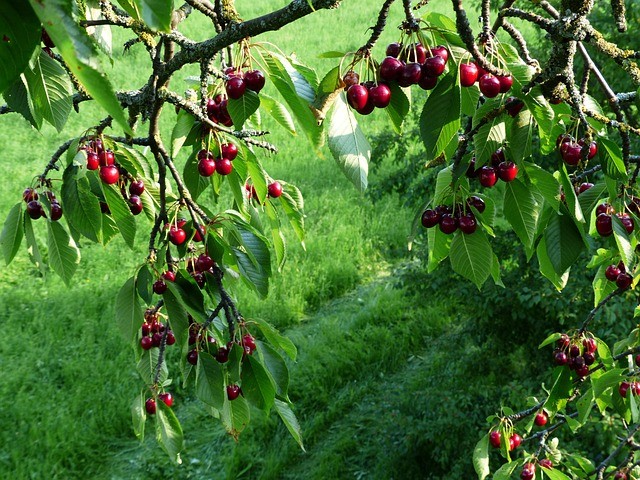
Bing cherry
Prunus avium
A large, firm-fleshed sweet cherry: deep mahogany to near-black when ripe, heart-shaped, hanging singly or in pairs on long slender stalks among drooping, doubly toothed leaves. 'Bing' is a mid to late season cultivar of wild cherry with dark red flesh, a small free stone and a rich, low-acid flavour, eaten fresh rather than cooked. Trees are grafted, so a stone will not come true.
Not a wild plant in Britain: a grafted orchard and garden tree, usually on a semi-dwarfing rootstock, planted in sheltered sunny positions on deep, well-drained soil. It is little grown commercially here because the fruit splits in wet summers. The parent species, wild cherry, is widespread in woods and hedgerows across Britain and Ireland.
The flesh is a straightforward edible with no preparation needed. The stones hold cyanogenic compounds, so do not crush or chew them and keep them from children and dogs. Cherry laurel (Prunus laurocerasus), widely planted in gardens and hedges, carries small dark fruit in erect spikes above evergreen leathery leaves rather than long-stalked fruit in ones and twos among deciduous toothed leaves; its kernels are toxic. Trees in gardens, car parks and along roads may have been sprayed.
Always use more than one reference to confirm a plant. You are responsible for what you choose to forage.
Fruit
Large, glossy, deep mahogany to almost black, broadly heart-shaped, hanging in ones and twos on long slender stalks. Fruit carried in erect or hanging spikes of many small berries is not a sweet cherry.
Flesh and stone
Firm, dark red, sweet and low in acid, with a single small hard stone that comes away cleanly. Soft, pale, sharply acid flesh points to a sour cherry rather than this cultivar.
Leaves
Oval to oblong, 6–15cm, doubly toothed and drooping, with one or two small reddish glands where the blade meets the stalk. Leathery evergreen leaves rule out cherry entirely.
Bark
Grey-brown and smooth on young wood, marked with horizontal bands of lenticels and peeling in ragged horizontal strips on older trunks.
Flowers
White, five-petalled, about 2.5–3.5cm across, in short-stalked clusters of two to six opening in April with the young leaves — not in long tapering spikes.
Updated 2026-08-08T12:03:00.469Z · Part of the shared Foragers Log catalogue · Fruit