What to forage in October
October is the mushroom peak. The boletes — porcini and bay bolete — are at their best in the woods alongside beefsteak and hen of the woods, sloes ripen on the blackthorn, and the last blackberries hang on in the hedges before the weather takes them. It is the classic month for a woodland forage, though it rewards care as much as enthusiasm: autumn is when the dangerous fungi are out too, so identify every mushroom fully and leave anything you are unsure of. Woodland, scrub and hedgerow all repay a walk. Take only firm, fresh specimens, check them over before they go in the basket, and never eat a wild mushroom you cannot name with certainty.
New in October
Just coming into season — their harvest window opens this month.
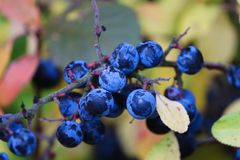
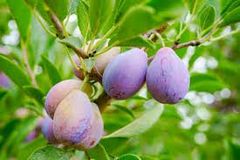
Prunus spinosa
Sloes are the small, dark purple fruits of the blackthorn bush, known for their tart flavor. Sloes are commonly found in hedgerows, woodland edges, and scrubland, thriving in sunny spots with well-drained soil across temperate regions.
Caution: Sloe bushes have sharp thorns that can cause injury during harvesting.
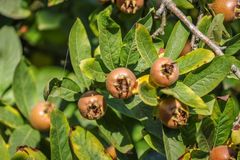
View field guide entry →Mespilus germanica
A small, crooked tree of old orchards and gardens, with large dull leaves, solitary white or blush flowers, and dense russet-brown fruit 2–3cm across.
Caution: Hard, unbletted fruit is mouth-puckeringly astringent rather than dangerous, and needs frost or several weeks of bletting before it is worth eating.
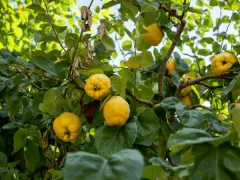
View field guide entry →Cydonia oblonga
A small, crooked orchard tree bearing large, lumpy, golden fruit covered in a grey woolly down that rubs off in the hand. A cultivated tree of old orchards, large gardens and churchyards, occasionally persisting in hedgerows and on waste ground near habitation.
Caution: The raw flesh is rock-hard and astringent rather than dangerous, but it is not worth eating uncooked; quince is cooked in every traditional use.
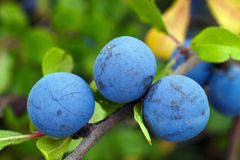
View field guide entry →Prunus spinosa
A dense, suckering shrub of hedge and scrub, almost black-barked, its stiff side-shoots ending in long sharp thorns. Hedgerows, wood edges, scrub and coastal thickets on most soils, common throughout Britain and Ireland.
Caution: The thorns puncture deeply and the wounds readily turn septic, so wear gloves and clean any scratch properly.
View field guide entry →Pyrus communis
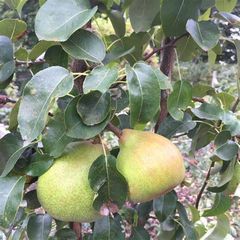
A large, squat dessert pear, broad and rounded at the base and tapering to almost no neck. Not a wild plant.
View field guide entry →Armoracia rusticana
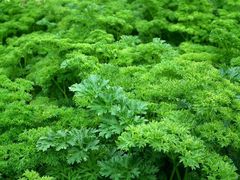
A coarse perennial crucifer forming a clump of long, glossy, dock-like leaves with wavy toothed edges, rising from a thick pale taproot. An established naturalised alien, originally from south-east Europe and western Asia.
View field guide entry →Platanus acerifolia
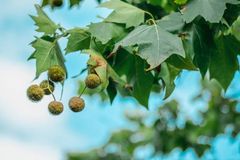
A large, spreading hybrid tree whose bark flakes away in irregular plates to leave a cream, olive and grey patchwork, with alternate leaves cut into three to five shallow triangular lobes.
Caution: There is no established food use for any part of this tree.
View field guide entry →Malus domestica
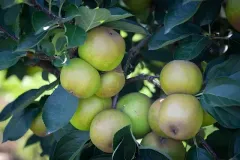
A small to medium dessert apple, flattish-round and almost wholly covered in fine golden-brown russet over a dull green-gold ground, sometimes with a bronze flush on the sunny cheek. A grafted orchard tree rather than a wild plant.
Caution: The flesh is safe raw and cooked.
View field guide entry →
At their peak in October
In the middle of their season and at their best right now.
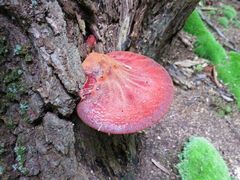
Fistulina hepatica
A thick, tongue- or liver-shaped bracket that grows singly low on the trunks of old oaks, usually within a metre or two of the ground.
Caution: Edible and not known to be poisonous, but the flesh is high in oxalic acid, so it is sour and best eaten in small amounts; anyone prone to kidney stones or gout may want to avoid it or seek advice.
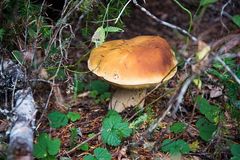
View field guide entry →Boletus edulis
A heavy, solid bolete with a smooth tan to chestnut cap that looks faintly greasy when damp and often keeps a paler rim, over a stout swollen stem marked with a fine pale network near the top.
Caution: No known toxins, but boletes are better cooked than raw, and old waterlogged caps or ones riddled with maggot tunnels can cause stomach upset.
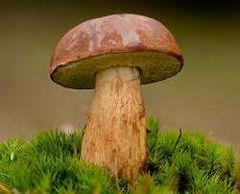
View field guide entry →Imleria badia
A brown bolete with a bay to deep chestnut cap, 4–15 cm across, matt and faintly velvety in dry weather but noticeably greasy after rain. Mycorrhizal with conifers, particularly Scots pine and spruce, and also with beech and oak.
Caution: Eat only cooked; like most boletes it is poorly tolerated raw.
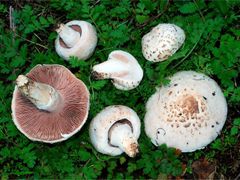
View field guide entry →Agaricus arvensis
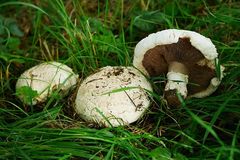
A stout white grassland mushroom with a cap 8–20 cm across, dry and silky, often splitting into pale scale-like patches as it expands. Saprotrophic, fruiting in unimproved pasture, meadows, lawns, verges and dune grassland, often where livestock have grazed and sometimes in arcs or rings.
View field guide entry →Agaricus campestris
A white, dry-capped mushroom of open grassland, usually 3–10 cm across, domed then flattening, with a silky to faintly scaly surface. Saprotrophic in nutrient-rich short grassland — grazed pasture, meadows, lawns, playing fields and stabilised dunes — appearing in scattered troops or arcs a few days after rain.
Caution: Eat cooked and young; raw or in quantity it disagrees with some people.
View field guide entry →Grifola frondosa
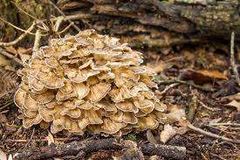
A large clustered polypore that grows as a rounded mass of overlapping grey-brown fronds at the foot of an oak, each frond a spoon-shaped cap arising from a branch of a common pale stem base.
View field guide entry →Cantharellus cibarius
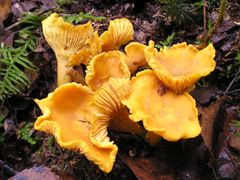
A firm, egg-yellow funnel with blunt, forking ridges running down onto a tapering stem rather than true gills. Mycorrhizal with broadleaves and conifers — oak, beech, birch and Scots pine — so it always pushes up from soil, moss or leaf litter, never from wood.
Caution: Cook thoroughly; raw or lightly cooked fruitbodies unsettle some stomachs.
View field guide entry →Malus domestica
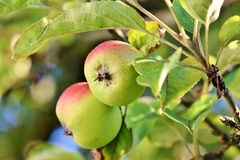
A small spreading tree with grey scaly bark and clusters of white, pink-flushed blossom in spring. Planted in orchards, gardens, allotments and churchyards, and widely naturalised from discarded cores along railway embankments, road verges, hedgerows and waste ground throughout Britain and Ireland.
Caution: The flesh is safe raw.
View field guide entry →
Last chance in October
The window is closing — these are largely done once the month turns.
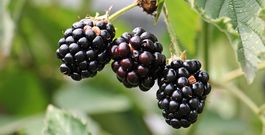
Rubus fruticosus
A scrambling, thorny shrub of the rose family that throws arching biennial canes over hedges, scrub and waste ground. Hedgerows, woodland edges and rides, scrub, railway banks, waste ground and neglected gardens, on almost any soil.
Caution: No part is toxic and the fruit needs no preparation, but pick above dog height and away from spray drift on arable field margins.
View field guide entry →Prunus domestica
A small deciduous tree or large shrub, usually 4–8 m, carrying oval to round fruit with a waxy bloom and a single flattened stone. Hedgerows, field margins, scrub, railway banks and abandoned orchards, often self-seeded from planted stock or spreading by suckers into thickets.
Caution: Ripe flesh is safe raw or cooked, but unripe fruit is astringent and can upset the stomach.
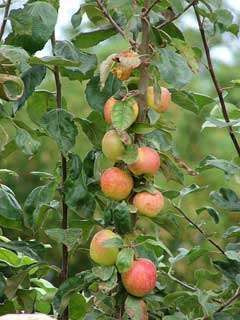
View field guide entry →Malus domestica
A garden and orchard cultivar of the domestic apple, raised in West Virginia in the 1890s and now one of the most widely planted eating apples in Britain.
Caution: Skin and flesh are safe raw and there are no dangerous lookalikes among apples.
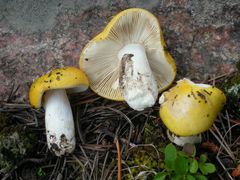
View field guide entry →Russula
Choice edible; cap bright egg-yolk yellow, convex then flattening with a slight central depression; surface sticky when moist, smooth when dry; cap cuticle peels halfway to the center; gills pale ochre, adnexed to almost free; white firm flesh that bruises grey slowly; fruity smell; pale ochre spore print.
Caution: Distinguished by its vivid yellow cap and habitat; similar species like Russula ochroleuca are duller and taste acrid.
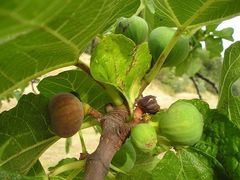
View field guide entry →Ficus carica
A deciduous shrub or small tree with stout grey shoots and large, leathery leaves cut into three to five blunt lobes and rough to the touch.
Caution: The milky latex in shoots, leaf stalks and unripe fruit contains psoralens and can blister skin that is then exposed to sunlight, so wash sap off and cover arms when picking in quantity.
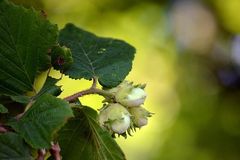
View field guide entry →Corylus avellana
A multi-stemmed shrub or small tree of woodland edge and hedgerow, sending up several smooth stems from one base rather than a single trunk. Native throughout Britain and Ireland, growing as understorey in oak and ash woodland and in old hedgerows, scrub and worked coppice.
Caution: Hazelnut is among the more frequent causes of serious tree nut allergy, so anyone with a nut allergy should avoid it entirely.
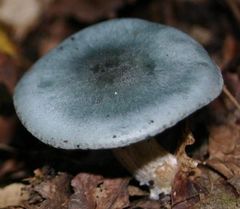
View field guide entry →Clitocybe
Edible (aromatic); strong anise scent; blue-green cap that fades; funnel-shaped Saprotrophic in leaf litter under deciduous (often beech) and occasionally coniferous trees; widespread in temperate woodlands
Caution: Risk of confusion with toxic Clitocybe species if color or scent is faded; best use specimens with strong anise aroma and vivid color
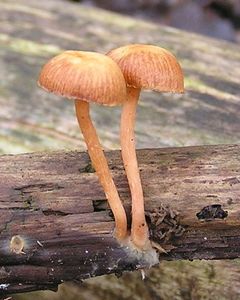
View field guide entry →Laccaria
Edible (mediocre); common; highly variable form and color—can deceive visually; often bland Mycorrhizal with deciduous and coniferous trees—beech, oak, birch, pine; found scattered or in troops in woodlands, heath, parks, and paths; very common in Britain & Ireland
View field guide entry →
The buckets above are capped at the most-logged species. For everything in season this month, browse the full October list in the field guide →
What foragers actually logged in October
In October, foragers logged 4,235 finds — one of the busier months in the app. The species recorded most were Beefsteak Fungus (628), Porcini (431), Bay Bolete (413), Chicken of the woods (344) and Horse Mushroom (337). Counts are aggregated across all foragers, with no location or personal detail.
Log your own finds
The calendar is built from what foragers record in the app. It's free, with no account needed to browse.

