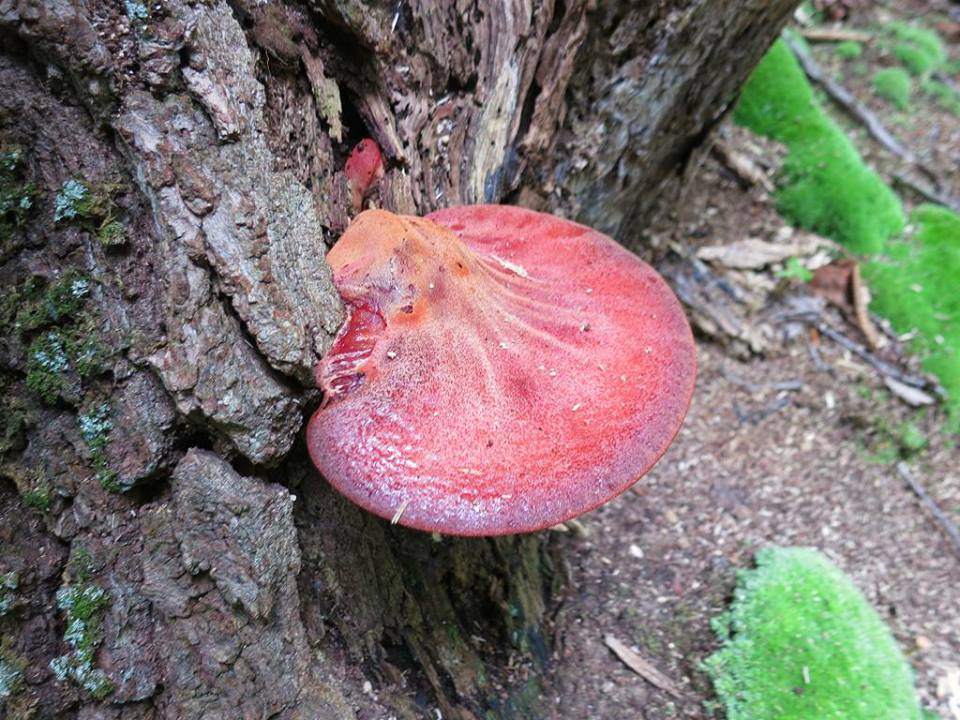
Beefsteak Fungus
Fistulina hepatica
A thick, tongue- or liver-shaped bracket that grows singly low on the trunks of old oaks, usually within a metre or two of the ground. The upper surface is damp, reddish and finely roughened, darkening to a dull liver colour with age; cut flesh is marbled pink and cream like raw meat and weeps a blood-red juice. The underside is not a solid pore layer but a mass of separate, closely packed tubes. Sour and acidic in flavour, it is taken young, sliced thinly, raw or briefly cooked.
Weakly parasitic and then saprotrophic on living oak, chiefly pedunculate and sessile oak, entering wounds and heart-rot at the base or low on the trunk and producing the brown staining timber merchants call brown oak; occasionally on sweet chestnut. Widespread in ancient parkland, wood pasture and old oak woodland throughout Britain and Ireland.
Edible and not known to be poisonous, but the flesh is high in oxalic acid, so it is sour and best eaten in small amounts; anyone prone to kidney stones or gout may want to avoid it or seek advice. Older brackets turn dark, corky and bitterly astringent — unpleasant rather than harmful. Trees at the base of trunks in parkland are often close to paths and dog-walking routes.
Always use more than one reference to confirm a plant. You are responsible for what you choose to forage.
Shape and position on the host
A single thick tongue or slab, often 10–25 cm across, attached by a short stubby stem or broadly to the bark, sitting low on a living oak trunk or at its base. It is fleshy and slightly rubbery to squeeze rather than woody, so it flexes under a thumb instead of snapping.
Upper surface
Damp, sticky and finely pimpled, blood-red to reddish-brown when fresh and darkening to a dull liver or blackish red as it ages. Wiping it leaves the surface tacky rather than dusty.
Underside of separate tubes
Cream to pale pink, and made of individual tubes standing side by side rather than a fused pore layer — rubbed with a thumb they part from one another. Bruises red-brown where handled, which is the quickest check once the bracket is in the hand.
Cut flesh and juice
Sliced through, the flesh is marbled pink and paler cream in streaks like raw steak and releases a blood-red juice that stains fingers and paper. No other fleshy UK bracket bleeds like this, so the cut is the decisive test if the tube layer is ambiguous.
Updated 2026-08-08T12:03:01.237Z · Part of the shared Foragers Log catalogue · Fungus