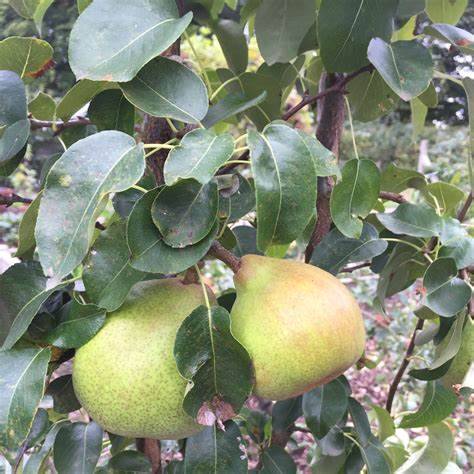
Comice Pear
Pyrus communis
A large, squat dessert pear, broad and rounded at the base and tapering to almost no neck. The skin is green ripening to greenish-yellow, usually flushed pink on the sunny side and freckled with brown russet; the flesh is pale, fine-grained and very juicy, without the grittiness of a cooking pear. Properly Doyenné du Comice, a nineteenth-century French cultivar long planted in British gardens and orchards, and one that ripens off the tree rather than on it.
Not a wild plant. Grafted trees stand in gardens, allotments and old commercial orchards, and frequently outlive the planting, persisting in scrub, hedge lines and along field edges. Commonest in southern and central England, where it needs warmth and shelter to ripen properly.
Ripe flesh is safe raw. The pips, like other pome seeds, contain cyanogenic compounds and are best not chewed in quantity. Softening fruit draws wasps, so open one before biting into it. Trees in orchards, gardens and allotments belong to someone, so ask before picking, and wash fruit taken from roadside trees.
Always use more than one reference to confirm a plant. You are responsible for what you choose to forage.
Fruit shape
Broad and rounded at the base, narrowing abruptly to a very short neck, so the outline reads closer to a fig than to the long, evenly tapering Conference pear.
Skin colour
Green ripening to greenish-yellow, usually with a warm pink to dull red flush where the sun reached it and scattered brown russet dots. A uniformly brown, evenly russeted skin points to Conference instead.
Leaves
Glossy, oval to broadly elliptic, finely toothed, carried on a long slender stalk, and smooth on the underside. Apple leaves on neighbouring trees are duller and grey-downy beneath.
Ripeness test
Press gently beside the stalk: that shoulder softens first, and once it yields the fruit wants eating within a day or two. Fruit left to soften on the tree usually rots from the core outwards.
Updated 2026-08-07T20:37:36.957Z · Part of the shared Foragers Log catalogue · Fruit