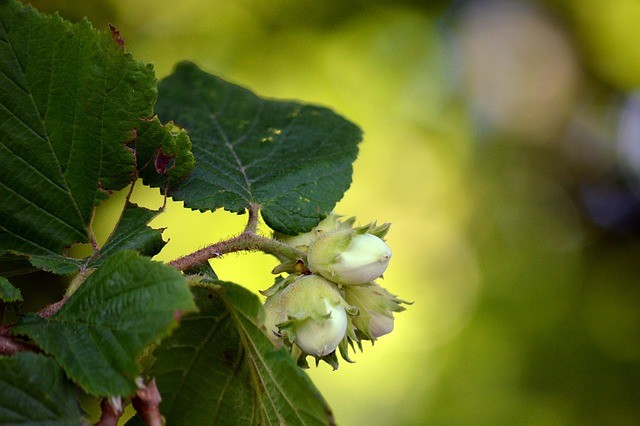
Hazel
Corylus avellana
A multi-stemmed shrub or small tree of woodland edge and hedgerow, sending up several smooth stems from one base rather than a single trunk. Yellow catkins hang from the bare twigs in late winter, and by early autumn clusters of nuts sit in ragged green husks. The kernels are eaten raw, roasted or ground.
Native throughout Britain and Ireland, growing as understorey in oak and ash woodland and in old hedgerows, scrub and worked coppice. Tolerates most soils but does best on damp, base-rich ground; abundant in limestone dales and in the Atlantic hazelwoods of the west coast.
Hazelnut is among the more frequent causes of serious tree nut allergy, so anyone with a nut allergy should avoid it entirely. Unripe green kernels are astringent rather than harmful. In wet autumns nuts pick up mould, so discard any that smell musty or rattle loose inside the shell.
Always use more than one reference to confirm a plant. You are responsible for what you choose to forage.
Several stems from a single base
Rarely a single trunk. Multiple straight stems rise together from one stool, giving an open vase shape 3–8m tall. Old coppiced stools can be several metres across with dozens of stems at different ages.
Round, soft, abruptly pointed leaves
Broadly rounded blades 6–12cm long, doubly toothed around the edge, with a short sharp point at the tip that looks stuck on rather than tapered into. Both surfaces are softly hairy and the leaf feels like felt between the fingers.
Yellow catkins through winter
Male catkins hang in pale yellow tassels 5–10cm long from January to March, well before any leaves. Look on the same twigs for the female flowers, which are barely more than a bud with a tuft of crimson threads a few millimetres across.
Nuts in a ragged open husk
Each nut sits in a leafy green husk with a torn, jagged edge that stops short of the tip, so the end of the nut stays visible. Husks that wrap past the nut into a long tube belong to a different species.
Smooth coppery bark with horizontal lines
Young stems are shiny grey-brown to coppery, marked with pale horizontal lenticels, peeling only in thin papery strips with age. Twigs and buds are covered in stiff hairs, and the buds are blunt, oval and set alternately.
Doubly toothed leaf with a soft, hairy underside
The margin carries small teeth set on larger ones, and the underside feels downy when stroked. Hornbeam leaves, the nearest match in a hedge, are narrower, drawn to a longer point and smooth beneath with strongly parallel veins.
Stiff reddish bristles on young twigs
Run a finger along a first-year shoot and it feels rough; under a lens the hairs are gland-tipped and rusty red. Older wood loses them, so check the newest growth at the shoot tip.
Husk shorter than the nut
The green husk is a ragged collar that leaves the end of the nut exposed. Cultivated filbert, Corylus maxima, wraps the nut in a longer fringed tube that hides it completely — a useful check on planted trees and old orchard hedges.
Tiny red female flowers
While the catkins are shedding pollen in February, look for pinhead tufts of crimson styles pressed against the twig on separate buds. These, not the catkins, become the nuts.
Updated 2026-08-08T12:03:15.402Z · Part of the shared Foragers Log catalogue · Fruit