London plane
Platanus acerifolia
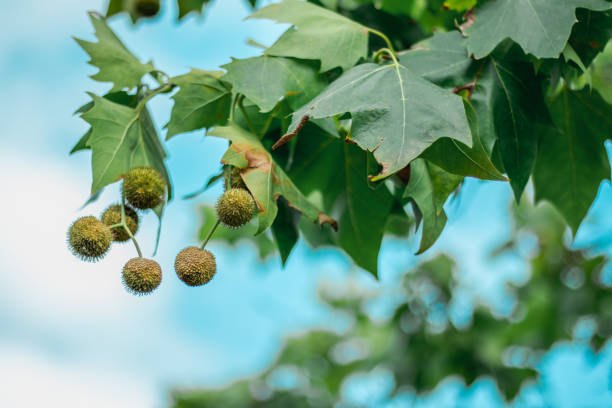
A large, spreading hybrid tree whose bark flakes away in irregular plates to leave a cream, olive and grey patchwork, with alternate leaves cut into three to five shallow triangular lobes. Bristly spherical seed heads hang on long stalks, usually in pairs, and persist through winter. Planted in vast numbers as a street tree; no part is used as food.
Not native and effectively never wild in Britain and Ireland: a planted tree of city streets, squares, parks and riverside walks, commonest in London and southern England. Tolerates compacted soil, restricted roots and polluted air, and occasionally self-sows on waste ground.
There is no established food use for any part of this tree. The seed heads break up into fine bristly hairs that irritate the eyes, nose and airways, so avoid crushing them or handling fallen balls in dry weather, and the spring pollen is a recognised urban allergen. Older trees shed bark plates and dead twigs in wind.
Always use more than one reference to confirm a plant. You are responsible for what you choose to forage.
Bark
Flakes off in irregular rounded plates, leaving a jigsaw of cream, olive-yellow and grey. Visible from across a street and the quickest way to separate a plane from any maple or hornbeam of similar size.
Leaves
Alternate along the twig, 10–20cm across, with three to five shallow triangular lobes and a long stalk whose swollen base sheathes the bud. Maple leaves of similar outline sit in opposite pairs.
Seed heads
Hard, bristly spheres about 3cm across, usually two or three on a drooping stalk, hanging bare through winter and breaking into hairy fluff in spring. Dry and inedible, not a fleshy fruit.
Form and setting
Tall with a heavy, often pollarded crown and stubby knuckled branch ends where it has been cut back. Almost always in a planted line or avenue rather than in woodland.
Updated 2026-08-07T21:15:30.988Z · Part of the shared Foragers Log catalogue · Fruit