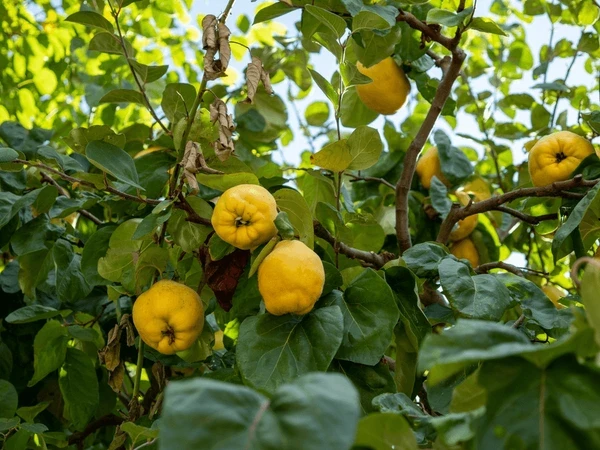
Quince
Cydonia oblonga
A small, crooked orchard tree bearing large, lumpy, golden fruit covered in a grey woolly down that rubs off in the hand. The flesh stays hard, sour and gritty when raw, but cooks to a deep rose colour and carries a heavy floral scent that will perfume a whole room. Long grown in Britain for jelly, membrillo and for scenting apple pies.
A cultivated tree of old orchards, large gardens and churchyards, occasionally persisting in hedgerows and on waste ground near habitation. Native to the Caucasus and northern Iran, it needs a warm, sheltered position to ripen properly, so fruits most reliably in southern Britain.
The raw flesh is rock-hard and astringent rather than dangerous, but it is not worth eating uncooked; quince is cooked in every traditional use. The pips contain cyanogenic compounds, so avoid crushing or chewing them and discard the core when making jelly or paste. Almost all British quince trees stand in gardens and orchards, so ask before picking.
Always use more than one reference to confirm a plant. You are responsible for what you choose to forage.
Habit
A small, thornless tree of 4–8m with a twisted, leaning trunk and an open, untidy crown. It is never a dense shrub and never bears spines.
Fruit
Large, 7–12cm, pear-shaped or apple-shaped and irregularly lumpy, clothed in grey wool when young that rubs away to a waxy gold. Unlike a pear, a ripe quince stays hard on the tree and does not soften in the hand.
Leaves
Oval, 6–11cm, dark green above and densely white-felted beneath, with a smooth untoothed margin. A toothed or glossy leaf rules quince out.
Flowers
Solitary, pale pink to white, around 5cm across, opening in May at the tips of leafy shoots after the leaves are out — not in clusters and not on bare wood.
Scent
A ripe fruit gives off a strong, sweet floral perfume noticeable from an arm's length and persisting for weeks indoors. No scent at all in October usually means the fruit is not yet ready.
Updated 2026-08-07T20:57:56.457Z · Part of the shared Foragers Log catalogue · Fruit