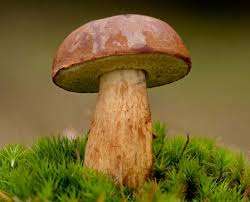
Bay Bolete
Imleria badia
A brown bolete with a bay to deep chestnut cap, 4–15 cm across, matt and faintly velvety in dry weather but noticeably greasy after rain. The pore surface beneath is cream to olive-yellow and bruises blue-green within seconds of being pressed, and the stout stem is streaked with brown fibres rather than netted. One of the more common autumn boletes in the UK, firm-fleshed and nutty, used fresh in cooking or sliced and dried.
Mycorrhizal with conifers, particularly Scots pine and spruce, and also with beech and oak. Favours acid, sandy or peaty soils in plantations, heathy woodland and woodland edges, often in moss or needle litter, and sometimes fruiting from rotting conifer stumps. Widespread across Britain and Ireland.
Eat only cooked; like most boletes it is poorly tolerated raw. Check the pores before picking — Bay Bolete's are cream to olive and bruise blue-green, whereas the Scarlet-stemmed Bolete (Neoboletus praestigiator) shares the dark brown cap but has orange-red pores and a red-dotted stem, and causes vomiting if eaten raw or undercooked. Older caps are frequently tunnelled by larvae. This species also takes up radiocaesium and heavy metals readily, so avoid repeated large meals from contaminated or roadside ground.
Always use more than one reference to confirm a plant. You are responsible for what you choose to forage.
Cap
Bay to chestnut brown, 4–15 cm across, smooth and evenly coloured. Slightly velvety when dry and distinctly tacky when wet, and it does not crack into a pale mosaic the way the smaller Xerocomellus boletes do.
Pores
Small, cream to olive-yellow, staining blue-green within a few seconds where pressed or cut. Yellow-toned pores are the check to make: red or orange pores mean a different fungus.
Stem
Pale brown, streaked lengthways with darker fibres, thickest near the middle. There is no raised white network on the upper stem, which is what a Penny Bun would show, and no red dots or scales.
Flesh and smell
White to pale yellow, firm in young caps, blueing faintly just above the tubes. The smell is mild and pleasantly mushroomy — anything sour or of ink is a reason to leave it.
Updated 2026-08-08T12:03:02.419Z · Added 2025-08-24T10:20:27.031Z
Part of the shared Foragers Log catalogue · Fungus