Fig
Ficus carica
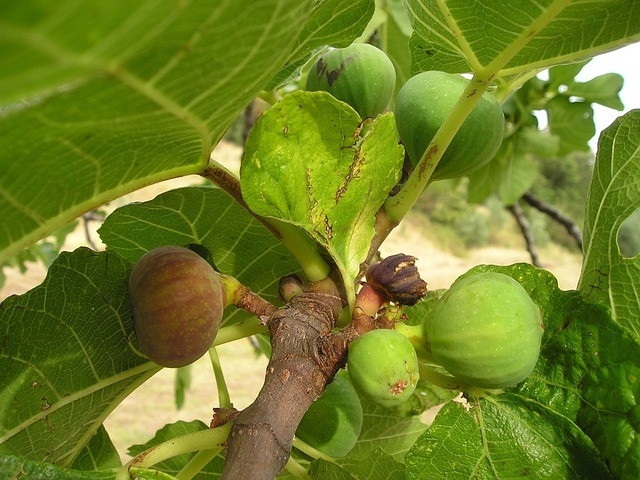
A deciduous shrub or small tree with stout grey shoots and large, leathery leaves cut into three to five blunt lobes and rough to the touch. What is picked as the fruit is a syconium: a hollow fleshy receptacle lined with hundreds of tiny flowers, ripening from green to purple-brown and softening as it swells. Cultivars grown in Britain set fruit without pollination, and are eaten fresh, dried or made into preserves.
Introduced from the Mediterranean and long planted against warm walls; naturalised in scattered places on railway banks, quarry spoil, riverside walls and urban waste ground, chiefly in southern England and around cities. Needs summer heat and shelter, and tolerates poor, limy, free-draining rubble.
The milky latex in shoots, leaf stalks and unripe fruit contains psoralens and can blister skin that is then exposed to sunlight, so wash sap off and cover arms when picking in quantity. Unripe figs are astringent and irritate the mouth. Ripe fruit is laxative if a lot is eaten at once. No dangerous lookalikes in Britain.
Always use more than one reference to confirm a plant. You are responsible for what you choose to forage.
Leaves
Large and thick, deeply cut into three to five rounded lobes, sandpapery above and downy beneath, on a long stout stalk. No other tree or shrub likely to be met on a British wall carries a leaf of this size and shape.
Fruit (syconium)
Pear-shaped and borne singly on a short stalk in the leaf axils, green ripening to purple-brown, with a small closed eye (the ostiole) at the tip. It is not a berry but a hollow receptacle; cut one open and the interior is packed with the actual flowers and seeds.
Milky latex
Snap a leaf stalk or pick an unripe fruit and white sap beads out immediately. This is the diagnostic test for a fig, and also the reason to keep sap off bare skin in sunlight.
Winter twigs
Smooth pale grey bark, stout blunt-tipped twigs with large round leaf scars, and small embryonic figs already sitting near the shoot tips. Those overwintering figlets are the ones that ripen the following summer, so a shrub cut back hard will carry nothing.
Ripeness test
A ripe fig softens at the neck, hangs downwards and may show a bead of syrup or a fine split in the skin. Fruit that is still firm and standing stiffly out from the shoot will taste only of latex however dark it looks.
Updated 2026-08-07T20:57:48.848Z · Part of the shared Foragers Log catalogue · Fruit