Medlar
Mespilus germanica
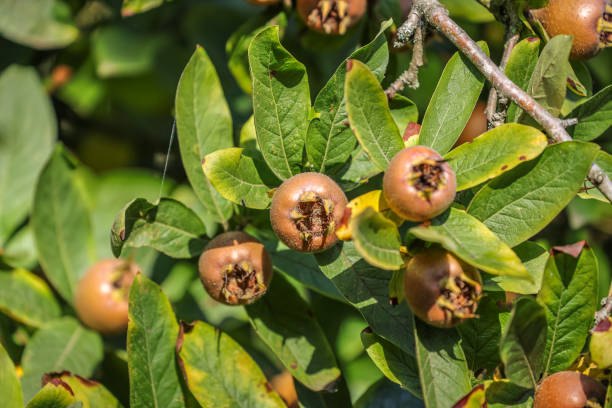
A small, crooked tree of old orchards and gardens, with large dull leaves, solitary white or blush flowers, and dense russet-brown fruit 2–3cm across. Each fruit is crowned by a wide open ring of persistent sepals around a hollow centre, which is the feature that settles the identification. The flesh is intensely astringent when hard and is eaten only after bletting, when it turns brown, soft and spiced-sweet; it is also used for jelly and fruit cheese.
Not native but long grown in Britain and Ireland, in old orchards, walled gardens, churchyards and large hedgerows; occasionally naturalised in scrub and woodland edge in southern and central England. Prefers sun and well-drained soil.
Hard, unbletted fruit is mouth-puckeringly astringent rather than dangerous, and needs frost or several weeks of bletting before it is worth eating. The pips are large and stony and should be discarded rather than chewed. Seedling trees may carry short spines. No dangerous lookalikes are recorded.
Always use more than one reference to confirm a plant. You are responsible for what you choose to forage.
Habit
A low, wide, often crooked tree to about 6m, with spreading and sometimes twisted branches. Rarely upright or forest-shaped, so it reads as an orchard survivor even from a distance.
Leaves
Large for a rose-family tree, 5–12cm, oblong to lanceolate, dull dark green above and hairy beneath, with fine teeth mainly towards the tip. Nothing like the deeply lobed leaf of a hawthorn.
Flowers
Solitary, 3–5cm across, white to pale pink with five broad petals, sitting singly at the tips of short shoots in May and June. Hawthorn and rowan carry their much smaller flowers in dense clusters.
Fruit and calyx
Russet-brown, flattened, 2–3cm across, and open at the tip inside a persistent ring of five long sepals surrounding a hollow. No other British tree fruit is open at the crown like this, which rules out quince, crab apple and haws at a glance.
Ripeness test
A picked fruit is ready only once it gives to a thumb and the flesh inside has gone brown and pulpy, roughly the texture of apple butter. Pale, firm flesh means it needs longer; slime and mould mean it has gone too far.
Updated 2026-08-07T20:52:33.070Z · Part of the shared Foragers Log catalogue · Fruit