Porcini
Boletus edulis
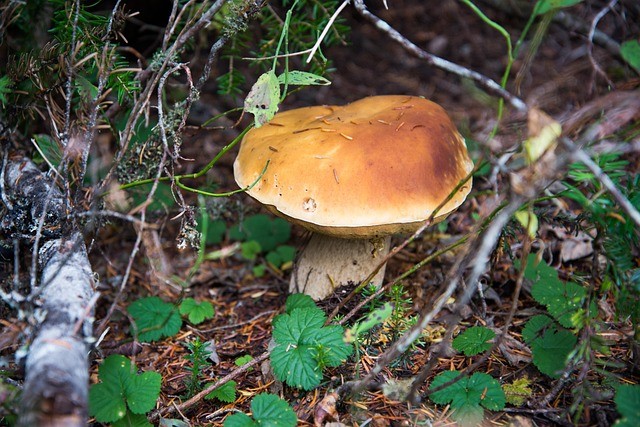
A heavy, solid bolete with a smooth tan to chestnut cap that looks faintly greasy when damp and often keeps a paler rim, over a stout swollen stem marked with a fine pale network near the top. The pore surface is white when young, ageing through cream to yellow and olive, and the white flesh stays white when cut. Firm and nutty, and the standard mushroom for drying.
Mycorrhizal, forming partnerships with beech, oak and birch and with pine and spruce, so it appears in both broadleaved woods and conifer plantations. Favours well-drained soil on woodland edges, mossy banks and the sides of paths and rides. Widespread across Britain and Ireland.
No known toxins, but boletes are better cooked than raw, and old waterlogged caps or ones riddled with maggot tunnels can cause stomach upset. Devil's Bolete (Rubroboletus satanas), toxic and found with beech on chalk in southern England, has red pores and a red-flushed stem and flesh that stains blue; this species has white to olive pores and flesh that stays white. Avoid picking from roadside verges.
Always use more than one reference to confirm a plant. You are responsible for what you choose to forage.
Cap
Typically 8–25 cm across, tan to deep chestnut, smooth and slightly tacky in wet weather rather than scaly or velvety. The margin is often a shade paler, sometimes with a thin whitish rim where it meets the pores.
Stem
Stout and club-shaped to bulbous, whitish to pale buff, with a fine raised white network over the upper part. No orange-brown or blackish scabrous scales, which would put it in Leccinum, and no red tones anywhere.
Pores and tubes
White and tightly packed when young, ageing cream, then yellow and finally olive, and easily separable from the cap flesh. They do not bruise blue on pressure. Pores flushing pink, with a coarse dark net on the stem, indicate the inedibly bitter Tylopilus felleus.
Flesh and taste test
White, dense and unchanging when cut. A nibble of raw flesh spat out afterwards tastes mild and faintly nutty; anything sharply bitter is not this species and the whole fruit body should be discarded, as the bitterness does not cook out.
Updated 2026-08-11T22:27:54.925Z · Part of the shared Foragers Log catalogue · Fungus