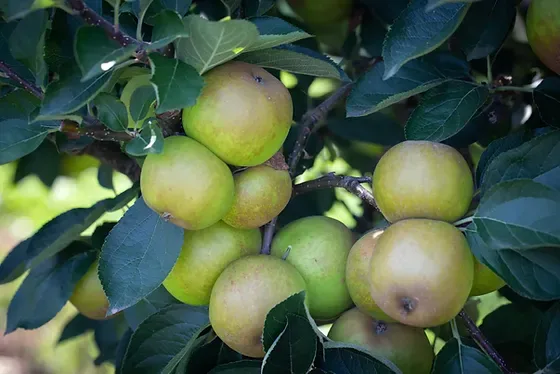
Ashmead's Kernel Apple
Malus domestica
A small to medium dessert apple, flattish-round and almost wholly covered in fine golden-brown russet over a dull green-gold ground, sometimes with a bronze flush on the sunny cheek. The flesh is dense, crisp and yellowish, with a sharp, aromatic pear-drop flavour that deepens after a few weeks in store. Raised in Gloucester around 1700 and still grown for eating fresh and for juice.
A grafted orchard tree rather than a wild plant. Found in old orchards, walled gardens and allotments across England, and persisting in hedgerows and rough ground where an orchard once stood. Prefers deep, well-drained soil and crops modestly.
The flesh is safe raw and cooked. Pips contain amygdalin and are best not chewed in quantity, though swallowed whole they pass through unharmed. Windfalls often hold wasps or brown rot, so check the inside before eating. Orchard trees, including those in derelict and overgrown orchards, are almost always owned; ask before picking, and be aware that managed orchards may have been sprayed.
Always use more than one reference to confirm a plant. You are responsible for what you choose to forage.
Skin and russet
Almost the whole fruit is wrapped in an even, matt, golden-brown russet over a dull green-gold ground. This is a full russet, not the patchy netting around the stalk that many part-russeted cultivars show.
Shape, stalk and eye
Flattish and broader than tall, faintly ribbed, with a short stout stalk sitting in a deep, heavily russeted cavity. The basin is shallow and the eye often part open — a squatter outline than the taller, conical shape of most modern dessert apples.
Flesh and flavour
Cut fruit shows firm, fine-grained, greenish-cream flesh that browns slowly. The juice is markedly sharp with a pear-drop or acid-drop note behind the sugar; a bland, soft or purely sweet apple under heavy russet is something else.
Behaviour in store
Keeps for months in a cool store, the skin turning slightly greasy to the touch and the flavour becoming richer rather than fading. Fruit eaten straight off the tree gives a poor impression of the cultivar.
Updated 2026-08-07T20:46:05.422Z · Part of the shared Foragers Log catalogue · Fruit