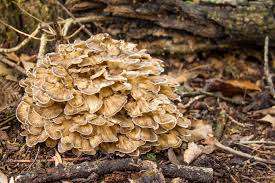
Hen of the Woods
Grifola frondosa
A large clustered polypore that grows as a rounded mass of overlapping grey-brown fronds at the foot of an oak, each frond a spoon-shaped cap arising from a branch of a common pale stem base. The pore surface is white and runs down the branches rather than stopping at a cap edge. Young growth is firm with a nutty, mealy smell and is well regarded in the kitchen, but it toughens quickly with age.
A weak parasite of living hardwoods, above all pedunculate and sessile oak, continuing afterwards as a saprotroph on the dead stump and roots; occasionally on beech, sweet chestnut or hornbeam. Look at trunk bases and over surface roots in old woodland, parkland and churchyards, commonest in southern and central England.
Edible when young and thoroughly cooked. The raw flesh is indigestible and a few people report stomach upset even after cooking, so try a small portion first. Older clumps turn tough and sour rather than dangerous. Fronds trap grit and insects, so wash and pick through carefully.
Always use more than one reference to confirm a plant. You are responsible for what you choose to forage.
Growth form
A single rounded clump, commonly 20–50 cm across and sometimes much larger, sitting tight against the base of a trunk or over a surface root. It never runs out along a fallen log the way a shelving bracket does.
Fronds
Many overlapping caps, each 4–10 cm across, spoon- or tongue-shaped with a wavy margin, greyish brown to fawn and finely streaked from the point of attachment outwards. All of them branch from one pale fleshy base.
Pore surface
White to cream, with small pores running down the branches rather than ending at a rim. It stays white when pressed and does not bruise black — the quickest way to rule out a blackening Meripilus clump on beech.
Smell and flesh
Cut flesh is white and pleasantly mealy, a little like raw hazelnut. Firm and slightly springy when young; if the fronds feel fibrous or leathery under the thumb the clump is too old to be worth taking.
Updated 2026-08-08T12:03:03.757Z · Added 2025-08-25T08:59:52.518Z
Part of the shared Foragers Log catalogue · Fungus