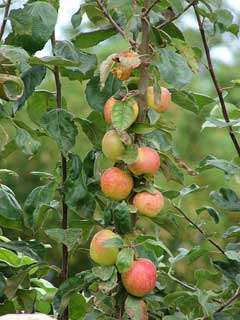
Golden Delicious Apple
Malus domestica
A garden and orchard cultivar of the domestic apple, raised in West Virginia in the 1890s and now one of the most widely planted eating apples in Britain. The fruit is medium to large and slightly conical, pale green ripening to an even greenish-gold, often with a scatter of fine brown lenticels and sometimes a faint blush where the sun has reached it. The flesh is cream-coloured, crisp when fresh and markedly sweet with very little acid, which makes it a keeper and an eater rather than a cooker. Foragers meet it most often as a relic of old plantings or as a feral seedling's parent rather than as a wild tree.
Not a native or truly wild tree: planted in gardens, allotments and commercial orchards on dwarfing or semi-dwarfing rootstock, and persisting in abandoned orchards long after the ground has gone over to scrub. Feral trees turn up on railway embankments, motorway verges and hedge banks where cores have been thrown, though seedlings do not come true to the parent. Prefers deep, well-drained soil, full sun and shelter from late frost, and needs a compatible pollinator nearby to set a crop.
Skin and flesh are safe raw and there are no dangerous lookalikes among apples. The pips contain amygdalin and are better not chewed in quantity, although swallowing a few whole does no harm. Windfalls gathered from verges and car parks may carry traffic residues or orchard spray, so wash before eating. Cultivated trees belong to someone: the wild-plant allowance in the Theft Act 1968 does not extend to fruit from a planted orchard, so ask first.
Always use more than one reference to confirm a plant. You are responsible for what you choose to forage.
Tree and habit
Usually a small, spreading tree of three to five metres on modern rootstock, with a distinct bulge or kink low on the trunk where the cultivar was grafted. That graft union is the quickest sign from a distance that a tree is a planted cultivar rather than a seedling crab or wild apple.
Fruit shape and colour
Medium to large, taller than it is wide and tapering slightly towards the calyx, with five faint bumps around the eye. Ripens from grass-green through greenish-yellow to a uniform gold, with no broad flat shoulders or heavy ribbing of the kind seen on cooking cultivars.
Skin markings
The skin is thin and dry rather than waxy, and carries scattered pale brown lenticels that can run into patches of light russet around the stalk. Where fruit has hung in full sun there may be a soft pink flush on one cheek, never the broad stripes of a red cultivar.
Blossom and pollination
White flowers opening from pink buds in mid to late spring, in clusters of five or six on short spurs. It flowers in the middle of the apple season and will not crop well alone, so a tree fruiting heavily in isolation is worth a second look at its identity.
Flesh and taste test
Cut flesh is pale cream and stays crisp, sweet and low in acid, with a honeyed note that builds in store. A sharp, mouth-puckering fruit that collapses to a froth on cooking is a culinary cultivar, not this one.
Updated 2026-08-07T20:52:30.006Z · Part of the shared Foragers Log catalogue · Fruit