What to forage in March
March is the month green returns in earnest. Wild garlic reaches its best, running in sheets across woodland; ground elder, cleavers and sorrel push up along hedges and verges; and cow parsley unfurls its first ferny leaves. That last one carries a warning that stays true all spring — the carrot family it belongs to also holds Britain's most poisonous plants, so identification has to be certain, not hopeful. Woodland, hedgerow and verge are all worth walking now. This is generous, leafy foraging and a good month to learn on, provided you leave plenty and stay well clear of anything you can't name.
New in March
Just coming into season — their harvest window opens this month.
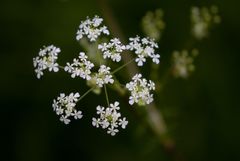
Anthriscus sylvestris
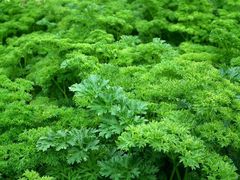
A tall, hollow-stemmed umbellifer that whitens road verges and hedgebanks from late April, carrying flat-topped clusters of small white flowers above soft, fern-like foliage cut two or three times into narrow segments.
Caution: Not a plant to pick until you can name every white umbellifer in the hedge.
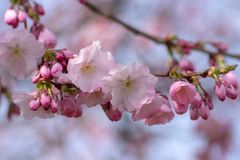
View field guide entry →Prunus subhirtella
A small ornamental cherry that flowers on bare wood in early spring, the pink semi-double blossom opening in stalked clusters before any leaves unfold. 'Accolade' is a garden hybrid grown for that display rather than for a crop; fruit sets sparsely if at all, and the small blackish cherries are bitter.
Caution: The flesh is not toxic, but the stones, leaves and twigs hold cyanogenic glycosides, so do not crush stones into a preserve or use the leaves as a tea.
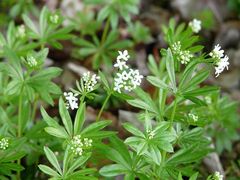
View field guide entry →Galium aparine
A sprawling annual that scrambles up through hedges and long grass rather than standing on its own. Hedge banks, woodland margins, riverbanks, gardens and disturbed waste ground, favouring damp, nitrogen-rich soil where it climbs through other vegetation for support.
Caution: No known toxicity, and the young shoots have a long record of use as a cooked green and as a tea.
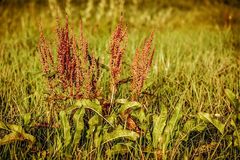
View field guide entry →Rumex acetosa
A slender grassland perennial with a basal rosette of arrow-shaped leaves, sharply sour from oxalic acid, and reddish flower spikes rising to knee height in early summer. Meadows, pastures, verges, woodland rides and upland grassland on neutral to acidic soils, from sea level to mountain ledges.
View field guide entry →
At their peak in March
In the middle of their season and at their best right now.
Allium ursinum
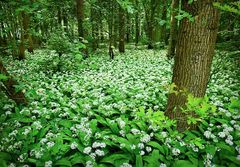
Broad, spear-shaped leaves rise singly from the woodland floor on long stalks, each one smelling strongly of garlic when crushed. Carpets damp, shaded broadleaf woodland, particularly on long-established woodland soils under beech, ash and hazel, and follows shaded stream banks and hedge bottoms.
Caution: Edible raw and cooked, though a lot of raw leaf can upset the stomach.
View field guide entry →Auricularia auricula-judae
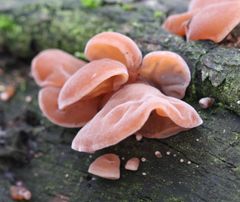
A soft, rubbery bracket shaped like a cupped ear, usually 3-8cm across, tan to deep reddish-brown, with folds and veins across the smooth inner face and a fine velvety bloom on the outside.
Caution: Cook it thoroughly; raw or barely cooked it sits badly with some people.
View field guide entry →Allium triquetrum
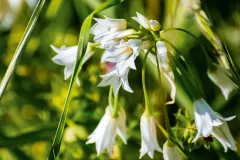
A slender spring allium with a sharply three-angled flowering stem and narrow, keeled leaves that smell strongly of garlic when crushed. A Mediterranean introduction, well naturalised on shaded hedge banks, woodland edges, churchyards, lane sides and damp verges, spreading by bulb offsets into dense carpets.
View field guide entry →Salvia rosmarinus
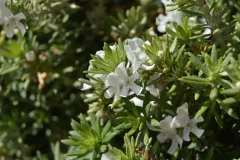
A dense evergreen shrub with woody, upright stems and stiff, needle-like leaves that are dark green above and pale grey-felted beneath, releasing a strong resinous, pine-and-camphor scent when crushed.
Caution: Safe as a culinary herb in ordinary cooking amounts; the concentrated essential oil is a different matter and is not for internal use.
View field guide entry →Laurus nobilis
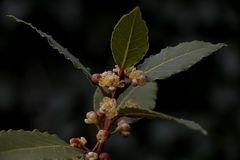
An evergreen shrub or small tree with stiff, glossy, dark green leaves that give off a warm, resinous scent when torn. Native to the Mediterranean and long planted in UK and Irish gardens, parks and churchyards, often as a clipped specimen or hedge.
Caution: The leaves are safe as a flavouring but stay stiff and sharp-edged after cooking, so lift them out before serving rather than swallowing them whole.
View field guide entry →Allium vineale
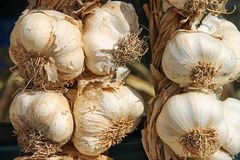
A slender grassland allium with hollow, cylindrical leaves that smell strongly of garlic when crushed. Dry, well-drained grassland: verges, field margins, churchyards, coastal turf and light sandy or disturbed ground.
Caution: Edible raw or cooked, but the flavour is strong and quantities of raw leaf or bulb can upset the stomach; people who react to onions and garlic should treat it the same way.
View field guide entry →Alliaria petiolata
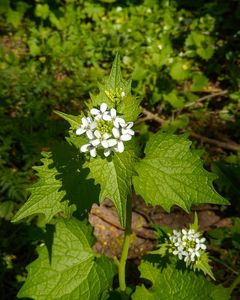
A tall, upright biennial of hedge banks and shaded verges, with heart- to kidney-shaped, bluntly toothed leaves that give off a clear garlic smell when crushed.
View field guide entry →Sarcoscypha austriaca
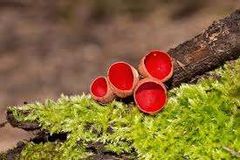
A small, vividly scarlet cup, usually 1–5cm across, sitting on damp deadwood through the coldest months. Saprotrophic on damp, decaying hardwood — commonly willow, hazel and elm branches lying half-buried in leaf litter or hidden under moss.
Caution: No dangerous lookalikes: the other UK Sarcoscypha species are separable only under a microscope and are regarded the same way.
View field guide entry →
Last chance in March
The window is closing — these are largely done once the month turns.
Betula
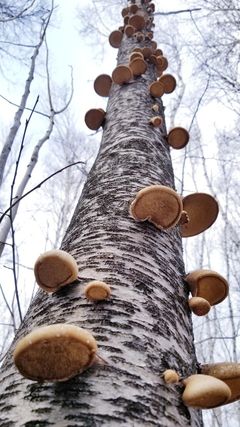
Birch Polypore is a bracket fungus that grows on birch trees, forming large, leathery, hoof-shaped fruiting bodies. Birch Polypore is found in UK woodlands and forests, particularly in areas with birch trees.
Caution: Although not toxic, Birch Polypore is tough and bitter, making it unsuitable for culinary use.
View field guide entry →Armoracia rusticana
A coarse perennial crucifer forming a clump of long, glossy, dock-like leaves with wavy toothed edges, rising from a thick pale taproot. An established naturalised alien, originally from south-east Europe and western Asia.
View field guide entry →
The buckets above are capped at the most-logged species. For everything in season this month, browse the full March list in the field guide →
What foragers actually logged in March
In March, foragers logged 1,837 finds — a decent sample. The species recorded most were Wild Garlic (997), Ground Elder (386), Plums (74), Chicken of the woods (69) and Apples (40). Counts are aggregated across all foragers, with no location or personal detail.
Log your own finds
The calendar is built from what foragers record in the app. It's free, with no account needed to browse.

