Cleavers
Galium aparine
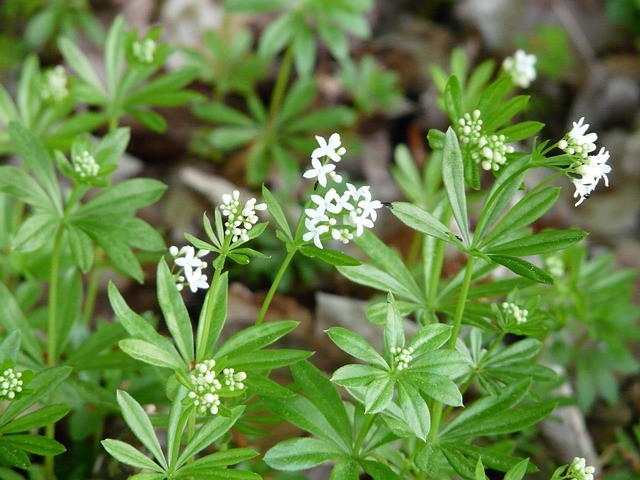
A sprawling annual that scrambles up through hedges and long grass rather than standing on its own. The square, brittle stems and the narrow leaves, set six to eight in a whorl, are covered in tiny backward-hooked bristles that catch on clothing and fur. Minute white four-petalled flowers are followed by paired burred fruits. Young shoots are picked in spring and cooked as a green or steeped as a tea; the ripe fruits are sometimes dried and roasted as a coffee substitute.
Hedge banks, woodland margins, riverbanks, gardens and disturbed waste ground, favouring damp, nitrogen-rich soil where it climbs through other vegetation for support. Common and widespread throughout Britain and Ireland, from the coast to upland field edges.
No known toxicity, and the young shoots have a long record of use as a cooked green and as a tea. Raw handfuls are unpleasant rather than harmful, since the hooked bristles catch in the mouth, and prolonged handling irritates some skins. It grows readily on verges and field margins where spray drift and nitrate enrichment are likely, so pick well back from roads and cultivated edges.
Always use more than one reference to confirm a plant. You are responsible for what you choose to forage.
Habit
Weak, straggling stems up to a metre or more, leaning and climbing through surrounding plants rather than self-supporting. A patch pulls away in one tangled mat.
Stems
Square in cross-section with rows of downward-hooked bristles along the angles. Draw a stem through a closed hand: it grips going one way and slides the other, which no other common bedstraw does.
Leaves
Narrow and lance-shaped, six to eight in a whorl, each tipped with a fine bristle point and edged with hooked hairs. The whorls are widely spaced along the stem, not crowded.
Flowers
Tiny, white and four-petalled, about 2mm across, in small stalked clusters arising from the leaf whorls. Sparse and easily missed rather than forming a froth of bloom.
Fruit
Paired globular burrs a few millimetres wide, densely covered in hooked bristles and sticking readily to clothing and animal coats. This burred fruit is the most reliable late-season confirmation.
Updated 2026-08-07T20:37:44.226Z · Part of the shared Foragers Log catalogue · Herb