Garlic Mustard
Alliaria petiolata
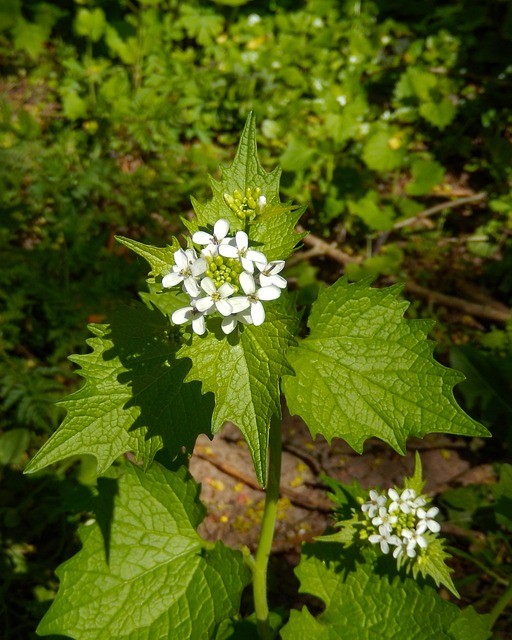
A tall, upright biennial of hedge banks and shaded verges, with heart- to kidney-shaped, bluntly toothed leaves that give off a clear garlic smell when crushed. Small white four-petalled flowers open in spring above a single leafy stem, followed by slender pods held close against it. The leaves are used raw in salads and sauces or wilted like a green, and the seeds as a pungent seasoning.
Hedge banks, woodland edges, shaded lanes, churchyards and disturbed ground on damp, fertile, base-rich soils, favouring dappled shade rather than deep woodland or open sun. Native and common throughout lowland Britain and Ireland, thinning out in the far north and at altitude.
Safe raw or cooked as a spring green, though the leaves turn markedly bitter once flowering begins and are better cooked from that point. The mustard oils and small amounts of cyanogenic compounds present make moderation sensible rather than eating it by the bowlful. Much of it grows on dog-walked verges and roadsides, so pick well back from the path.
Always use more than one reference to confirm a plant. You are responsible for what you choose to forage.
Toothed leaves on clear stalks
Heart-shaped to triangular blades with large rounded teeth around the edge, each held out on a distinct stalk rather than sitting close against the stem. First-year plants carry rounder, more kidney-shaped leaves in a low rosette.
Garlic smell when crushed
Tear a leaf and rub it. There is a clear garlic smell with a mustard sharpness underneath, quite unlike the pure onion note of Ramsons. The smell fades within a minute or two, so judge it on the first crush, and check on a clean hand if you have been picking already.
Four white petals in a cross
Small flowers around 6mm across, each with four petals set opposite in pairs, clustered at the top of the stem from April into June. The four-petalled cross places it in the cabbage family and rules out anything bell-shaped or five-petalled.
Long thin seed pods held upright against the stem
From early summer, slender four-sided pods 2–6cm long point upwards and sit close to the stem, giving the plant a distinctly narrow, vertical look from a distance. Picked green they have a sharp mustard heat.
Single unbranched stem, waist high
Second-year plants send up one straight stem, usually 30cm to a metre, with leaves spaced up it and getting smaller towards the top. It stands in loose groups rather than forming a dense carpet.
First-year rosette of long-stalked kidney-shaped leaves
In its first year the plant is a low rosette of scalloped, kidney-shaped leaves on long stalks, present through mild winters. There is no flowering stem at this stage, so the crush test rather than the flower is what confirms it.
Leaf shape changes up the stem
Basal and lower leaves are rounded to kidney-shaped, while leaves higher up the flowering stem become triangular and more sharply pointed. A plant showing both shapes at once is a useful confirmation from a couple of metres away.
Thin white taproot smelling of horseradish
The slender pale taproot is pungent and horseradish-like rather than garlicky, unlike the bulb of wild garlic. Digging is only worth it on ground you have permission to disturb.
Updated 2026-08-08T12:03:15.043Z · Part of the shared Foragers Log catalogue · Herb