Bay
Laurus nobilis
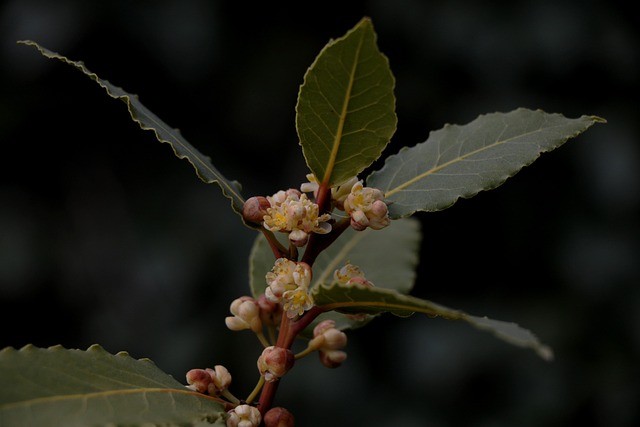
An evergreen shrub or small tree with stiff, glossy, dark green leaves that give off a warm, resinous scent when torn. The leaves are alternate, narrowly oval with a finely wavy margin, on short stalks; small creamy-yellow flowers appear in the leaf axils in spring, and female plants carry glossy black berries in autumn. Grown and picked for the leaf, used fresh or dried to flavour stocks, stews, milk puddings and marinades.
Native to the Mediterranean and long planted in UK and Irish gardens, parks and churchyards, often as a clipped specimen or hedge. Self-sows and suckers into hedgerows, walls and waste ground in milder southern and coastal areas; foliage scorches in exposed northern frost pockets.
The leaves are safe as a flavouring but stay stiff and sharp-edged after cooking, so lift them out before serving rather than swallowing them whole. Handling the foliage brings on contact dermatitis in a few people. Cherry laurel (Prunus laurocerasus), the common hedging shrub, smells of marzipan or almonds when a leaf is crushed rather than warm and resinous, and its leaves are broader, softer and glossy on both surfaces; it is cyanogenic and has no kitchen use. Spurge laurel (Daphne laureola) carries thin, flexible leaves crowded in rosettes at the shoot tips and gives no aromatic scent when torn; all parts of it are poisonous.
Always use more than one reference to confirm a plant. You are responsible for what you choose to forage.
Leaf shape and texture
Stiff and leathery, roughly 5-10 cm long, narrowly oval with a pointed tip and a finely wavy margin, matt dark green above and paler beneath. Cherry laurel leaves are larger, softer and flat-edged, and shine on both surfaces.
Crushed-leaf scent
Tear a leaf across and smell it: warm, resinous and faintly clove-like. A marzipan or almond smell means cherry laurel; no scent at all points to spurge laurel. This is the decisive test in the field.
Flowers and fruit
Small creamy-yellow flowers in tight clusters in the leaf axils in April and May, male and female on separate plants. Female trees carry single-seeded berries that ripen glossy black in autumn; the berries are not used in cooking.
Habit and bark
A multi-stemmed shrub or small tree, frequently clipped into a standard or hedge, branching from low down with smooth olive-grey bark. Leaves are held all year, so the plant is as findable in January as in July.
Updated 2026-08-07T20:57:49.263Z · Part of the shared Foragers Log catalogue · Herb