What to forage in April
April is the busiest month of the spring, and the easiest to forage well. Wild garlic and ground elder are everywhere, young nettles are at their tender best before they toughen and flower, and the hedgerows thicken with new growth by the day. This is the month to build confidence: the plants are abundant, familiar and forgiving, and there is enough of everything that taking a modest share leaves no mark. Woodland, hedgerow, riverbank and neglected corners of waste ground all repay a walk. Pick the youngest leaves, wear gloves for the nettles, and enjoy the one stretch of the year when wild greens are genuinely plentiful.
New in April
Just coming into season — their harvest window opens this month.
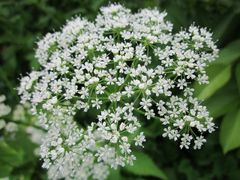
Aegopodium
Ground Elder is a perennial plant in the carrot family, known for its aggressive growth and spreading habit. Ground Elder thrives in shady, damp areas such as woodlands, hedgerows, and gardens, often forming dense colonies.
Caution: Ground Elder can be invasive, spreading rapidly via underground rhizomes and difficult to control once established.
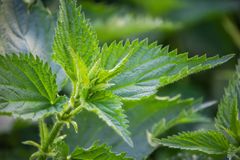
View field guide entry →Urtica
Stinging Nettle is a herbaceous perennial plant known for its stinging hairs that can cause skin irritation. Stinging Nettle is commonly found in moist, nitrogen-rich soils, particularly in woodlands, grasslands, along riverbanks, and disturbed areas like roadsides or gardens.
Caution: Stinging Nettle is covered in tiny, needle-like hairs that release irritants upon contact, causing a stinging sensation and rash.
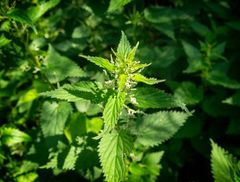
View field guide entry →Urtica
Nettle is a fast-growing herb known for its stinging hairs that cause skin irritation. Commonly found in woodlands, hedgerows, and disturbed areas like roadside verges.
Caution: Nettle's stinging hairs can cause skin irritation and allergic reactions.
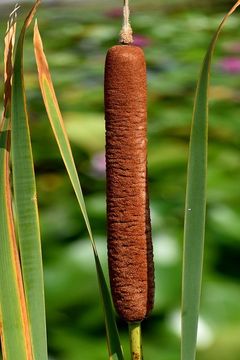
View field guide entry →Typha latifolia
A tall emergent perennial of still fresh water, spreading by thick creeping rhizomes into dense, often single-species stands.
Caution: No toxins are recorded in the plant, but the best parts sit underwater: rhizomes take up pollutants and bacteria from the water they grow in, so leave stands fed by road runoff, farm drainage or sewage.
View field guide entry →Foeniculum vulgare
A tall aromatic perennial umbellifer with thread-fine, almost hair-like blue-green foliage and flat-topped umbels of small yellow flowers on stout ridged stems, often standing over head height by late summer.
Caution: The plant itself is a well-established food species, though the seeds and concentrated preparations are eaten in small culinary amounts rather than by the handful.
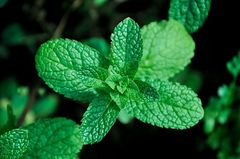
View field guide entry →Mentha
Mint is a fragrant herb with square stems, pointed oval leaves, and a fresh, cooling scent when crushed. Found in gardens, near streams, damp meadows, hedgerows, and occasionally on roadsides.
Caution: Can be confused with other aromatic herbs or invasive mint-like species.
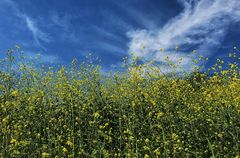
View field guide entry →Brassica nigra
A tall, wiry annual crucifer reaching two metres, with bristly, lyre-shaped lower leaves, smooth narrow upper ones, and loose spikes of small yellow four-petalled flowers. A plant of open, disturbed ground: arable margins, waste ground, riverbanks, shingle and coastal cliffs, on well-drained fertile soil.
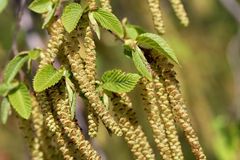
View field guide entry →Carpinus betulus
A medium-sized deciduous tree with smooth grey bark that is shallowly fluted, so the trunk looks sinewy rather than round. Native to south-east England, mostly on heavy clay and chalk in oak woodland and old coppice, and widely planted across Britain and Ireland as a street tree, park tree and clipped hedge.
Caution: No recorded toxicity, and no preparation is required for young leaves, though older summer leaves turn tough and bitter and the nutlets are hard enough to be more work than food.
View field guide entry →
-443952.jpg?alt=media&token=1d645d2f-24f7-44b6-8b54-5f1d9cf6d811)
At their peak in April
In the middle of their season and at their best right now.
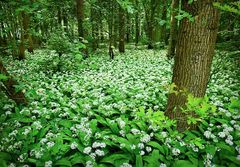
Allium ursinum
Broad, spear-shaped leaves rise singly from the woodland floor on long stalks, each one smelling strongly of garlic when crushed. Carpets damp, shaded broadleaf woodland, particularly on long-established woodland soils under beech, ash and hazel, and follows shaded stream banks and hedge bottoms.
Caution: Edible raw and cooked, though a lot of raw leaf can upset the stomach.
View field guide entry →Alliaria petiolata
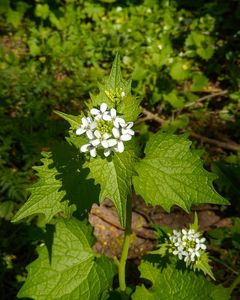
A tall, upright biennial of hedge banks and shaded verges, with heart- to kidney-shaped, bluntly toothed leaves that give off a clear garlic smell when crushed.
View field guide entry →Auricularia auricula-judae
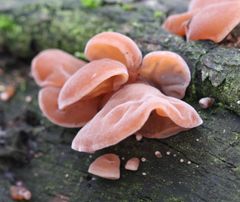
A soft, rubbery bracket shaped like a cupped ear, usually 3-8cm across, tan to deep reddish-brown, with folds and veins across the smooth inner face and a fine velvety bloom on the outside.
Caution: Cook it thoroughly; raw or barely cooked it sits badly with some people.
View field guide entry →Galium aparine
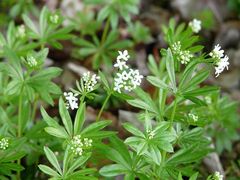
A sprawling annual that scrambles up through hedges and long grass rather than standing on its own. Hedge banks, woodland margins, riverbanks, gardens and disturbed waste ground, favouring damp, nitrogen-rich soil where it climbs through other vegetation for support.
Caution: No known toxicity, and the young shoots have a long record of use as a cooked green and as a tea.
View field guide entry →Allium triquetrum
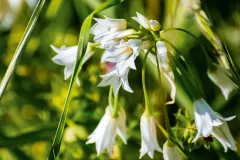
A slender spring allium with a sharply three-angled flowering stem and narrow, keeled leaves that smell strongly of garlic when crushed. A Mediterranean introduction, well naturalised on shaded hedge banks, woodland edges, churchyards, lane sides and damp verges, spreading by bulb offsets into dense carpets.
View field guide entry →Allium schoenoprasum
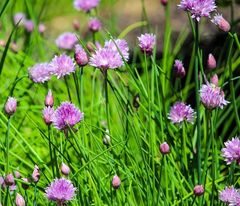
Dense tufts of hollow, cylindrical grey-green leaves rise 20–40 cm from a cluster of narrow bulbs, topped through summer by tight pink-mauve globes of bell-shaped flowers. A scarce native of dry limestone rock and thin grassland, with a handful of long-known sites in Cornwall, Wales and Cumbria.
Caution: Generally safe raw or cooked, though large quantities of any allium can upset a sensitive stomach.
View field guide entry →Taraxacum officinale
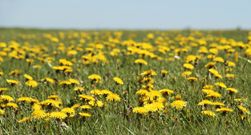
A low rosette perennial with deeply toothed leaves whose lobes point back towards the base, and a single golden flowerhead of strap-shaped florets carried on a hollow, leafless stem that bleeds white latex when snapped.
Caution: Not known to be toxic, though the milky latex can irritate sensitive skin and quantities of leaf are markedly diuretic.
View field guide entry →Beta vulgaris maritima
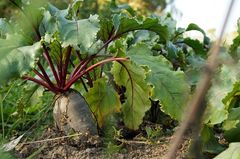
The wild ancestor of beetroot, chard and sugar beet: a sprawling coastal perennial with thick, glossy, dark green leaves, often flushed red, on ribbed reddish stems. A plant of the splash zone: shingle, sand, sea walls, cliff bases, the drier upper edges of saltmarsh and the top of strandlines.
Caution: Leaves are eaten cooked and, sparingly, raw, but like chard and spinach they carry oxalic acid, so anyone prone to kidney stones may prefer modest, cooked quantities.
View field guide entry →
The buckets above are capped at the most-logged species. For everything in season this month, browse the full April list in the field guide →
What foragers actually logged in April
In April, foragers logged 6,158 finds — one of the busier months in the app. The species recorded most were Wild Garlic (3,862), Ground Elder (1,340), Chicken of the woods (213), Plums (194) and Blackcurrant (99). Counts are aggregated across all foragers, with no location or personal detail.
Log your own finds
The calendar is built from what foragers record in the app. It's free, with no account needed to browse.

