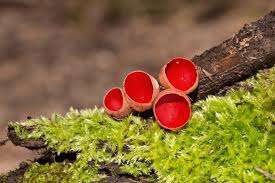
Scarlet Elf Cup
Sarcoscypha austriaca
A small, vividly scarlet cup, usually 1–5cm across, sitting on damp deadwood through the coldest months. The inner face is smooth and glossy vermilion, the outside paler and minutely downy, with little or no stalk. Separating it from its near-identical relatives needs a microscope, though all are treated the same way in the kitchen: thin, near-flavourless flesh that makes it more of a find to photograph than to cook.
Saprotrophic on damp, decaying hardwood — commonly willow, hazel and elm branches lying half-buried in leaf litter or hidden under moss. Shaded, humid woodland, stream banks and wet gullies; widespread but local across Britain and Ireland, most frequent in the wetter west.
No dangerous lookalikes: the other UK Sarcoscypha species are separable only under a microscope and are regarded the same way. The flesh is thin and almost tasteless and eating records are sparse, so cook rather than sample raw. Fruit bodies are small and often locally scarce, so take few or none.
Always use more than one reference to confirm a plant. You are responsible for what you choose to forage.
Cup and colour
A shallow scarlet cup 1–5cm across, often in small clusters, flattening and becoming wavy or split at the margin with age. The comparable Orange Peel Fungus (Aleuria aurantia) is orange rather than scarlet and grows from bare soil on paths and banks, never from wood.
Outer surface
Paler pinkish-white to buff and covered in fine matted hairs, so the cup looks two-toned when tilted. A smooth, hairless outer surface points away from this species.
Attachment and substrate
Attached by a very short stalk or directly to dead hardwood, which is frequently buried under moss or litter. If you clear the base and find soil rather than wood, it is not this.
Season
One of the few conspicuous fungi fruiting from late autumn through to spring, often alongside frost. A scarlet cup found in high summer is something else.
Microscopic separation
Distinguishing it from Sarcoscypha coccinea depends on the hairs of the outer surface being strongly coiled and on spore shape and dimensions; both species are equally harmless, so the check matters for records rather than for safety.
Updated 2026-08-08T11:01:34.534Z · Part of the shared Foragers Log catalogue · Fungus