What to forage in January
January is the low point of the foraging year, and honesty helps more than optimism here — little is fruiting, and a cold snap shuts most of it down. What there is rewards a patient eye: the first wild garlic leaves spearing through damp woodland, jelly ear clinging to old elder, and a few tough fungi persisting on dead and standing wood. Roots and evergreen leaves are the mainstay for anyone determined. Walk damp broadleaf woodland and elder stands rather than open ground, go slowly, and take only a little — everything is working hard to get through winter, foragers included.
New in January
Just coming into season — their harvest window opens this month.
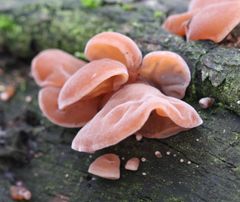
Auricularia auricula-judae
A soft, rubbery bracket shaped like a cupped ear, usually 3-8cm across, tan to deep reddish-brown, with folds and veins across the smooth inner face and a fine velvety bloom on the outside.
Caution: Cook it thoroughly; raw or barely cooked it sits badly with some people.
View field guide entry →Salvia rosmarinus
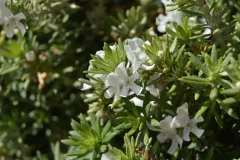
A dense evergreen shrub with woody, upright stems and stiff, needle-like leaves that are dark green above and pale grey-felted beneath, releasing a strong resinous, pine-and-camphor scent when crushed.
Caution: Safe as a culinary herb in ordinary cooking amounts; the concentrated essential oil is a different matter and is not for internal use.
View field guide entry →Allium triquetrum
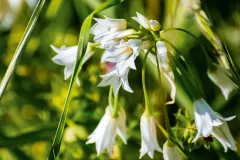
A slender spring allium with a sharply three-angled flowering stem and narrow, keeled leaves that smell strongly of garlic when crushed. A Mediterranean introduction, well naturalised on shaded hedge banks, woodland edges, churchyards, lane sides and damp verges, spreading by bulb offsets into dense carpets.
View field guide entry →
At their peak in January
In the middle of their season and at their best right now.
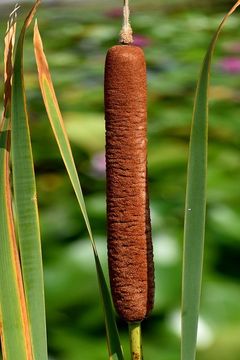
Typha latifolia
A tall emergent perennial of still fresh water, spreading by thick creeping rhizomes into dense, often single-species stands.
Caution: No toxins are recorded in the plant, but the best parts sit underwater: rhizomes take up pollutants and bacteria from the water they grow in, so leave stands fed by road runoff, farm drainage or sewage.
View field guide entry →Exocarpos cupressiformis
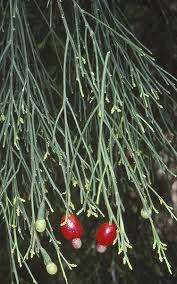
A slender, weeping shrub or small tree whose fine drooping branchlets read as cypress rather than cherry, the true leaves reduced to minute scales so the green stems do the photosynthesising.
Caution: The edible part is the swollen fleshy stalk; the hard nut at its tip is astringent and normally spat out, as is any fruit picked before it turns translucent red.
View field guide entry →Betula
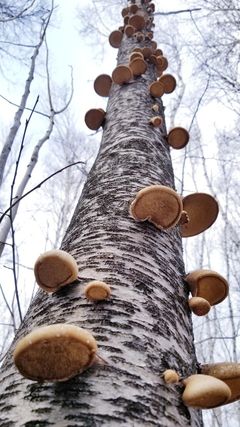
Birch Polypore is a bracket fungus that grows on birch trees, forming large, leathery, hoof-shaped fruiting bodies. Birch Polypore is found in UK woodlands and forests, particularly in areas with birch trees.
Caution: Although not toxic, Birch Polypore is tough and bitter, making it unsuitable for culinary use.
View field guide entry →Armoracia rusticana
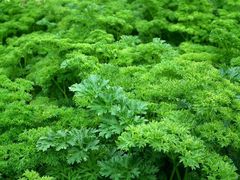
A coarse perennial crucifer forming a clump of long, glossy, dock-like leaves with wavy toothed edges, rising from a thick pale taproot. An established naturalised alien, originally from south-east Europe and western Asia.
View field guide entry →Sarcoscypha austriaca
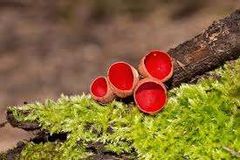
A small, vividly scarlet cup, usually 1–5cm across, sitting on damp deadwood through the coldest months. Saprotrophic on damp, decaying hardwood — commonly willow, hazel and elm branches lying half-buried in leaf litter or hidden under moss.
Caution: No dangerous lookalikes: the other UK Sarcoscypha species are separable only under a microscope and are regarded the same way.
View field guide entry →
The buckets above are capped at the most-logged species. For everything in season this month, browse the full January list in the field guide →
What foragers actually logged in January
In January, foragers logged 406 finds — a smaller sample, so treat it as a rough guide rather than a trend. The species recorded most were Wild Garlic (78), Chicken of the woods (54), Jelly ear fungus (36), Blackberry (21) and Ground Elder (18). Counts are aggregated across all foragers, with no location or personal detail.
Log your own finds
The calendar is built from what foragers record in the app. It's free, with no account needed to browse.

