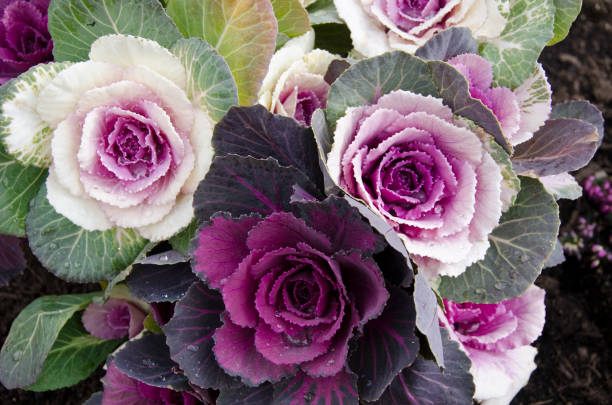
Cabbage
Brassica oleracea
A stout biennial brassica with thick, waxy, blue-green leaves and a heavy pale midrib, grown for the dense leafy head formed in its first year. Cultivars run from loose spring greens through smooth-leaved summer ballheads to crinkled savoys that stand through frost. Left to run, the plant bolts in its second year into a tall raceme of pale yellow four-petalled flowers. The wild form, sea cabbage, is a sprawling perennial-looking plant of coastal cliffs with the same sulphurous smell when a leaf is torn.
Grown across Britain and Ireland on deep, firm, limed soil in open ground; frequent as a garden and allotment relic. The wild form is scattered on chalk and limestone sea cliffs and shingle, mainly on southern and eastern coasts.
No toxicity of note raw or cooked, though large quantities of raw brassica can cause bloating and wind. Wild plants sit on crumbling cliff edges, where the ground is the real hazard, and coastal colonies are small enough to be worth taking a leaf or two from rather than a whole rosette. Avoid plants at the foot of walls and verges used by dogs.
Always use more than one reference to confirm a plant. You are responsible for what you choose to forage.
Leaves
Thick, hairless and coated in a waxy bloom that rubs off grey on a thumb, with a broad whitish midrib and net of raised veins. The bloom and the hairlessness separate it at a glance from the softer, hairy leaves of most coastal rosette plants.
Head
First-year plants fold their inner leaves into a tight head, round, flattened or pointed depending on cultivar, sitting on a short stub of stem. Wild and bolted plants form no head at all, just an open rosette.
Stem base
Older wild plants build a thick, woody, scarred stem below the rosette, marked with the crescent scars of fallen leaves. This woody base is the surest sign of an established wild cabbage rather than a garden escape of the season.
Flowers
In the second year, a tall spike of pale lemon-yellow flowers with four petals in a cross, opening from the bottom upwards, followed by long slender pods. Flowering leaves are tough and bitter and not worth picking.
Smell
A torn leaf gives the familiar sulphurous cabbage smell within seconds. If a coastal grey-green rosette has no brassica smell when crushed, it is not this plant.
Updated 2026-08-08T07:14:29.759Z · Part of the shared Foragers Log catalogue · Vegetable