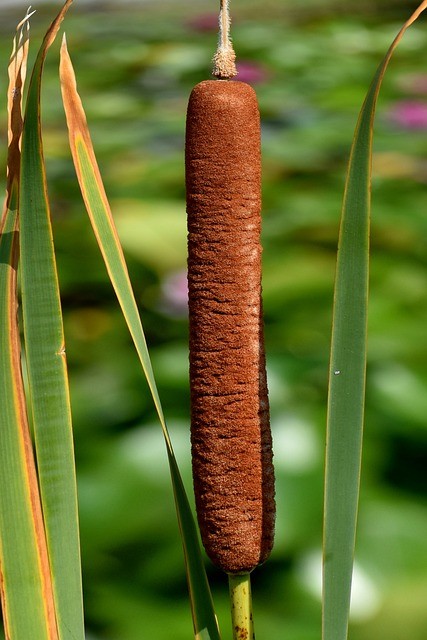
Cattail
Typha latifolia
A tall emergent perennial of still fresh water, spreading by thick creeping rhizomes into dense, often single-species stands. Grey-green strap leaves reach around 2 m, and the flowering stem carries a dark brown, sausage-shaped female spike with a slimmer male spike directly above it. Better known in Britain as bulrush or great reedmace. Peeled young shoots, green flower spikes and rhizome starch are all eaten, and the pollen can be shaken off as a yellow flour.
Rooted in mud in shallow standing or slow-moving fresh water — pond and lake margins, ditches, canals, flooded gravel pits and the edges of marsh and reedbed, usually in less than 30 cm of water. Common and widespread across lowland Britain and Ireland, thinning out at altitude.
No toxins are recorded in the plant, but the best parts sit underwater: rhizomes take up pollutants and bacteria from the water they grow in, so leave stands fed by road runoff, farm drainage or sewage. Digging rhizomes uproots the plant and needs the landowner's permission. Out of flower the leaves can be taken for Yellow Flag (Iris pseudacorus), whose rhizome is acrid and sickening and whose leaves rise in flat fans with a raised midrib, rather than spirally from a spongy base with no midrib.
Always use more than one reference to confirm a plant. You are responsible for what you choose to forage.
Flower spike
The brown, sausage-shaped female spike sits directly beneath the narrower male spike, with no bare stem between the two. In Lesser Bulrush (Typha angustifolia) a gap of roughly 1–8 cm separates them; the hybrid is intermediate and best left alone if you are trying to name it.
Leaves
Flat, grey-green straps up to about 2.5 cm wide, arranged spirally up the stem and sheathing it at a spongy base, with no raised midrib. Iris leaves by contrast are held in flat fans and carry a distinct central ridge — the check to make when no spike is present.
Colony habit
Grows as a crowded, even-topped stand rising straight out of shallow water, all of it linked underground by thick, pale, horizontal rhizomes. Scattered single stems among other marsh plants are worth a second look.
Pollen and seed head
In early summer the male spike sheds bright yellow pollen freely — a bag pulled over the head and shaken collects it. By late winter the female spike breaks up into cotton-wool fluff, which is the point at which the season is over.
Updated 2026-08-08T10:14:07.020Z · Part of the shared Foragers Log catalogue · Fruit