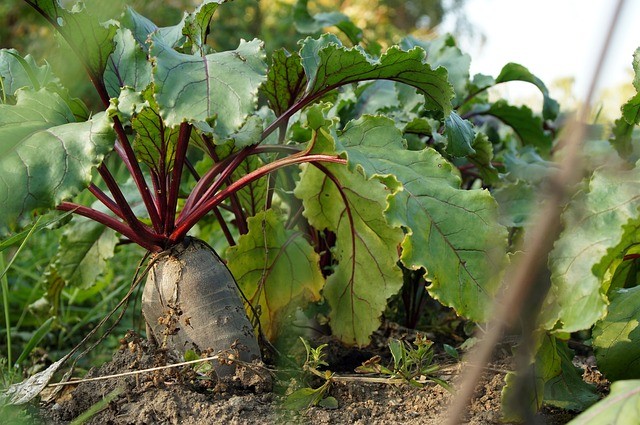
Sea beet
Beta vulgaris maritima
The wild ancestor of beetroot, chard and sugar beet: a sprawling coastal perennial with thick, glossy, dark green leaves, often flushed red, on ribbed reddish stems. Tiny green petal-less flowers sit in long spikes. The leaves cook down like chard, with a faintly salty, mineral edge, and the fleshy midribs can be treated as a separate vegetable.
A plant of the splash zone: shingle, sand, sea walls, cliff bases, the drier upper edges of saltmarsh and the top of strandlines. Salt-tolerant and effectively confined to the coast, common around England, Wales and Ireland and thinning northwards in Scotland.
Leaves are eaten cooked and, sparingly, raw, but like chard and spinach they carry oxalic acid, so anyone prone to kidney stones may prefer modest, cooked quantities. Wash strandline and saltmarsh plants thoroughly and avoid sites near outfalls or heavily walked paths. Picking leaves is fine on land you have access to; uprooting a wild plant without the landowner's permission is an offence.
Always use more than one reference to confirm a plant. You are responsible for what you choose to forage.
Leaves
Thick, leathery and distinctly glossy, as though waxed, in a rough triangle or diamond shape with a wavy edge and a pale prominent midrib. Often flushed dark red or purple. The shine and thickness separate it from the dull, mealy grey-green leaves of the oraches and goosefoots that share the same shingle.
Habit
Sprawls rather than stands, forming low mats or loose clumps over shingle and sand, with stems flopping outward from a woody crown. Perennial, so the same plants reappear on the same patch of beach year after year.
Stems
Ribbed and grooved, usually reddish at the base, becoming wiry and almost woody as the season goes on. Flowering stems can rise to a metre or so and are much tougher than the leafy ones.
Flowers and seed
Tiny green flowers with no petals, clustered in small knots along long, near-leafless spikes from midsummer. Seed clusters harden into knobbly, corky lumps that persist into winter and make the plant recognisable long after the leaves are past picking.
Smell and taste
No noticeable smell when crushed. A raw leaf tip tastes mildly salty and earthy, like chard; a bitter or resinous taste means you are holding something else and should stop.
Updated 2026-08-07T20:37:43.784Z · Part of the shared Foragers Log catalogue · Fruit