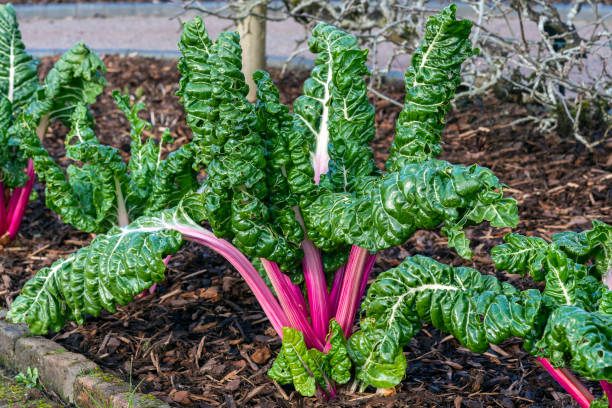
Swiss Chard
Beta vulgaris cicla
A cultivated leaf beet grown for its foliage rather than a root. The leaves are large, glossy and puckered, deep green or bronze, carried on broad flattened stalks that run white, yellow, orange or deep crimson. Botanically the same species as beetroot, selected instead for leaf and midrib: the blades cook down like spinach, while the thick stalks are usually cooked separately and eat closer to celery.
A garden, allotment and market-garden plant in Britain and Ireland rather than a wild one, grown in open ground on deep, moisture-retentive soil in sun or light shade. It occasionally appears as a short-lived escape on tips and disturbed ground but rarely persists; its wild ancestor, sea beet, grows on shingle, sea walls and coastal banks.
Safe cooked, and safe raw in modest quantity. The leaves are high in oxalic acid, so anyone prone to kidney stones may prefer to keep large raw servings down; boiling and discarding the water reduces the load. Like other leaf crops it takes up nitrate, so avoid heavily fertilised plots and roadside beds.
Always use more than one reference to confirm a plant. You are responsible for what you choose to forage.
Leaf stalk and midrib
Broad, flattened and fleshy, often two to five centimetres across, in white, cream, yellow, orange or crimson, with the colour running up into the veins of the blade. This heavy celery-like stalk is the quickest way to tell chard from spinach, which has thin, round, unremarkable stalks.
Leaf blade
Large, oval to oblong, glossy and strongly puckered or blistered between the veins, often 20 to 40 centimetres long. Spinach leaves are smaller, thinner and usually smooth or only lightly crumpled.
Growth habit and root
An open rosette rising from a crown at soil level, with a thin fibrous taproot and no swollen storage root. Pulling one up settles it against beetroot, which is the same species but forms the familiar rounded root.
Second-year flowering
Biennial: in its second spring it throws up a tall, ribbed, branching stem to well over a metre with tiny green flowers in clusters along the branches. Once this begins the leaves toughen and turn bitter, and the plant is finished for picking.
Updated 2026-08-08T11:01:36.776Z · Part of the shared Foragers Log catalogue · Vegetable