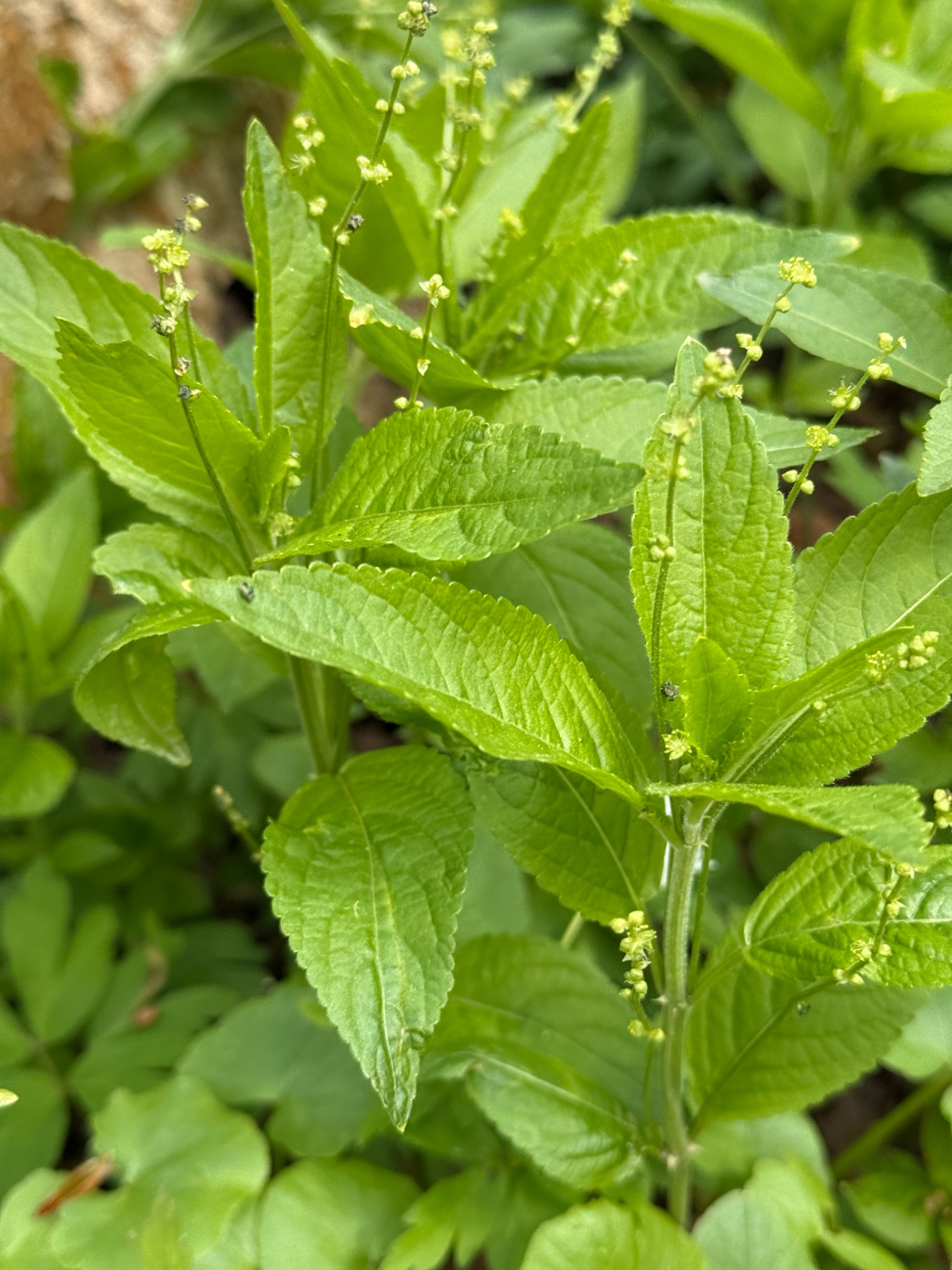
Dog's Mercury
Mercurialis perennis
This species is poisonous and can cause serious illness. Listed here so you can recognise and avoid it.
A low, unbranched woodland perennial, rarely above knee height, with matt and softly hairy leaves in opposite pairs and slender spikes of tiny green flowers. It spreads by underground rhizomes into dense carpets across the floor of old woods, often to the exclusion of everything else. All parts are poisonous; it is recorded here as a plant to recognise and leave, not to gather.
Shaded floor of ancient broadleaved woodland, particularly on base-rich and chalky soils, and on shaded hedge banks and in limestone grikes. Widespread through England and Wales, thinner in Scotland and very rare in Ireland.
Poisonous. All parts contain irritant and blood-damaging compounds, and cooking does not make them safe; eating even a small quantity can bring on vomiting, diarrhoea, jaundice and kidney damage. The mistake that causes most poisonings is gathering it in spring for Ramsons (Allium ursinum): the leaves here sit in opposite pairs up a standing stem and smell rank when crushed, while Ramsons leaves rise singly from ground level and smell strongly of garlic.
Always use more than one reference to confirm a plant. You are responsible for what you choose to forage.
Single unbranched stem, knee-high at most
A plain upright stem 15–40cm tall with no side shoots, rising singly from the ground and repeated over a wide area to form a continuous green carpet. There is no basal rosette and no broad blade coming straight out of the soil.
Leaves in opposite pairs up the stem
Oval to lance-shaped leaves with shallowly toothed edges, set in facing pairs at each node on very short stalks. Leaves arranged singly, alternately or all from ground level belong to something else.
Softly hairy and matt throughout
Run a finger over the stem and leaf surface and you will feel short fine hairs. The whole plant is dull mid-green with no gloss and no waxy sheen.
Rank smell when crushed or wilting
Bruised foliage gives off a stale, faintly fishy, unpleasant smell that grows stronger as the plant wilts. This is the decisive test in spring woodland: if crushing a leaf releases any garlic or onion smell at all, the plant in your hand is not this one.
Tiny green flowers, male and female on separate plants
From February to May. Male plants carry small green flowers in slender erect spikes held clear of the leaves; female plants carry a few short-stalked flowers with a hairy two-lobed ovary. There are no petals and nothing that reads as a bloom from a distance.
Leaf shape and toothed margin
Leaves are 3–8 cm, elliptical to lance-shaped, finely toothed along the edge and set on a short stalk. Wild garlic leaves, the plant it is most often mistaken for, are untoothed, broader and carried on long stalks straight from the ground.
Creeping rhizome forming single-sex carpets
It spreads underground into large clonal patches, so a whole carpet is usually all male or all female. A stand of uniform, evenly spaced stems with no other ground flora between them is characteristic.
Paired bristly capsules on female plants
Female plants carry small two-lobed, roughly hairy capsules on drooping stalks from the leaf joints. Male plants have only slender spikes of stalked green flowers and never set these capsules.
Early emergence and early die-back
Shoots push through in late winter, well before the tree canopy closes, and the whole plant withers away by late summer, leaving bare woodland floor where the carpet stood.
Updated 2026-08-08T12:03:12.514Z · Added 2026-07-19T12:46:29.712Z
Part of the shared Foragers Log catalogue · Other