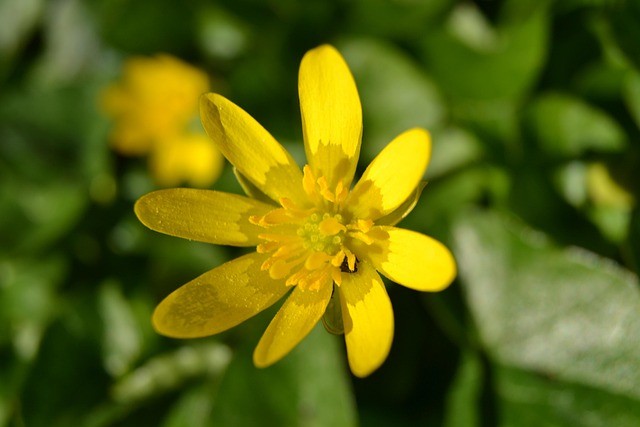
Lesser celandine
Ficaria verna
Eating this will make you ill. Listed here so you can recognise and avoid it.
A low spring perennial that forms glossy carpets on damp ground, with long-stalked heart-shaped leaves, often marbled with paler or darker patches, and solitary yellow flowers of eight to twelve narrow, varnished petals. The whole plant dies back by early summer, leaving clusters of pale finger-like root tubers. It is little used as food now: all parts are acrid raw, and traditional use was confined to young leaves boiled and drained.
Damp, shaded, fertile ground — woodland floors, hedge banks, stream sides, churchyards, damp lawns and neglected gardens — usually on heavy soils. Widespread and common throughout Britain and Ireland, appearing from January and gone above ground by June.
All parts are acrid raw: the ranunculin they contain converts to protoanemonin, which blisters the mouth and irritates the gut, and the sap can inflame skin on handling. Only young pre-flowering leaves were traditionally eaten, thoroughly boiled in at least one change of water; acridity rises sharply once the plant flowers, and the tubers are not worth the risk. Marsh marigold (Caltha palustris), also acrid and toxic raw, shares the same damp ground, but its leaves are 5–15 cm across and kidney-shaped and its flowers have five broad yellow sepals rather than eight to twelve narrow petals.
Always use more than one reference to confirm a plant. You are responsible for what you choose to forage.
Habit and season
Forms dense low carpets a few centimetres tall, one of the first things to green up on a damp woodland floor. Flowers January to April, then yellows and vanishes entirely by early summer, leaving bare ground.
Flower
Solitary, glossy yellow, 2–3 cm across, with eight to twelve narrow petals backed by three green sepals. The petal count separates it at a glance from the true buttercups (Ranunculus species), which have five broad petals.
Leaves
Bluntly heart- to kidney-shaped, 2–5 cm across, dark glossy green and often marbled with silver or purplish blotches, each on a long channelled stalk from the base. Untoothed or only shallowly lobed — never divided or lobed like a buttercup leaf.
Roots and bulbils
Digging up a plant reveals a cluster of small pale tubers like swollen fingers, the feature that names the genus. Some populations also produce tiny cream bulbils in the leaf axils after flowering, which is one of the characters used to separate the subspecies.
Updated 2026-08-08T07:14:28.242Z · Part of the shared Foragers Log catalogue · Herb