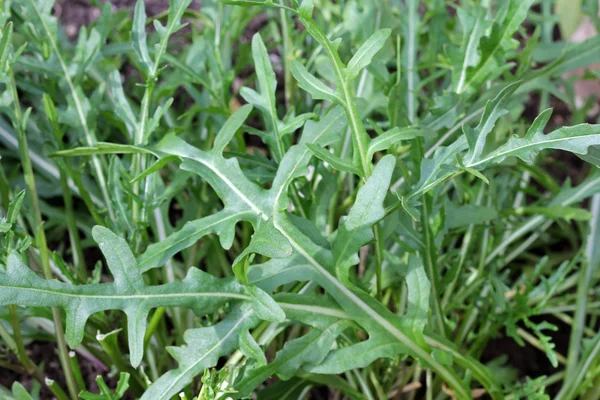
Wild rocket
Diplotaxis tenuifolia
A perennial crucifer with deeply cut, narrow-lobed greyish leaves rising from a woody base, sending up branched stems 30–80 cm tall carrying four-petalled bright yellow flowers through the summer. The crushed leaf is sharply peppery and more bitter than the salad rocket of the greengrocer, and it holds that heat well into the season. Leaves are used raw in salads, wilted into pasta and stirred through sauces; the flowers are edible too.
Naturalised on dry, disturbed ground — railway ballast, brownfield sites, wall bases, quarry spoil, car parks and coastal shingle. Commonest in southern and eastern England, thinning northwards, and still spreading along transport corridors.
Generally safe raw or cooked, though the mustard heat becomes harsh and bitter once the plant is flowering, so pick young leaves for salads. Its favoured ground is roadsides, railway edges and urban waste ground, where vehicle grime, spray and dog fouling are the real risk rather than the plant itself. Wash well and avoid verges within a metre or two of traffic.
Always use more than one reference to confirm a plant. You are responsible for what you choose to forage.
Flowers
Four bright yellow petals in a cross, roughly 1–1.5 cm across, in loose clusters on branching stems from June to autumn. Any daisy-like head of many small florets is a composite, not a rocket.
Leaves
Deeply pinnately lobed with narrow, often toothed lobes, greyish-green and smooth. Narrower and more finely cut than salad rocket's broad, shallowly lobed leaves.
Smell and taste
Crush a leaf: a strong peppery, mustard-oil smell with a bitter edge, stronger than shop rocket and stronger again after flowering. No mustard smell means it is not a rocket.
Habit and base
A clump-forming perennial from a tough woody rootstock, regrowing repeatedly after cutting and persisting on the same patch of ground for years, rather than dying off after seeding as the annual wall-rockets do.
Seed pods
Slender pods 2–5 cm long, held on a short stalk above the point where the sepals were attached, with the seeds in two rows inside — the two-ranked arrangement the genus is named for.
Updated 2026-08-08T06:52:55.665Z · Part of the shared Foragers Log catalogue · Herb