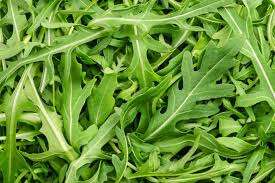
Rocket
Eruca vesicaria
A sprawling annual crucifer with deeply lobed, rocket-shaped leaves and a hot, peppery mustard flavour that sharpens as the plant runs up to flower. The four-petalled flowers are creamy white to pale yellow with clear violet-brown veining, which is unusual in the cabbage family and settles the identification quickly. Grown as a salad leaf and naturalised here and there on disturbed ground; leaves, flowers and green pods are all eaten.
Widely grown in gardens and allotments, and naturalised sporadically from seed on waste ground, tips, railway ballast and disturbed sandy soil, mainly in southern and central England. Favours open, dry, sunny ground with little competition.
No eating toxicity is known in the leaves, flowers or young green pods, though the mustard oils are strong enough to irritate some mouths when the plant is eaten raw in quantity. Leaves take up nitrate readily, so pick from clean open ground rather than fertilised field margins or dog-walked verges. Unflowered rosettes are far less distinctive than the flowers; crush a leaf and check for the peppery mustard smell before picking any crucifer you cannot see in flower.
Always use more than one reference to confirm a plant. You are responsible for what you choose to forage.
Flowers
Four petals, creamy white to pale yellow, each marked with violet-brown veins running its length. That veining is the fastest confirmation from a couple of metres away and rules out the plain yellow flowers of the other salad rockets and the yellow-flowered wild mustards.
Leaves
Pinnately lobed with a large rounded end lobe and two to five pairs of narrower side lobes, soft and slightly fleshy, carried on a clear stalk. Broader and more succulent than the narrow, wiry, deeply dissected leaves of wild rocket.
Seed pods
Short and plump, held erect and pressed close to the stem, each tipped with a flat sword-shaped beak roughly a third of the pod's length. The long flat beak separates it from the slender beakless pods of the wild mustards.
Habit
An annual, usually 20-60cm, with a branching, sparsely bristly stem that flops outwards as it ages. It does not form the tough woody base of a perennial rocket.
Smell and taste
A crushed leaf gives a warm mustard smell, and a nibbled edge is peppery with heat that builds. No peppery heat means it is not this plant, whatever the leaf shape suggests.
Updated 2026-08-08T11:01:37.688Z · Part of the shared Foragers Log catalogue · Herb