Sage
Salvia officinalis
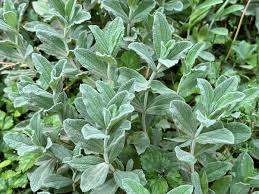
A low, woody sub-shrub with soft grey-green leaves held in opposite pairs on square stems, the leaf surface finely pebbled and covered in short hairs. Short spikes of two-lipped violet flowers open in early summer. The leaves are strongly aromatic, camphor and pine over a warm bitterness, and hold their scent when dried, which is why they carry stuffings, sausages and butter sauces. Grown in gardens rather than found wild.
A Mediterranean shrub grown here in gardens and allotments; it wants sun and sharp drainage and will not persist in wet or heavy ground. In Britain and Ireland it occurs beyond cultivation only as a short-lived relic or escape on walls, dry banks and old garden sites, mostly in the south.
Safe in the quantities used in cooking. The leaves contain thujone, which becomes a concern in concentrated essential oil or in strong sage teas taken daily rather than in seasoning; anyone pregnant or drinking it medicinally is worth pointing at a pharmacist. Plants picked from verges and car park beds carry the usual roadside dust.
Always use more than one reference to confirm a plant. You are responsible for what you choose to forage.
Habit
A mounded evergreen sub-shrub 40–60 cm tall, woody and peeling at the base with square, softly hairy young stems. The permanent woody framework is visible in winter, which is what separates it from the herbaceous wild sages.
Leaves
Oblong to lance-shaped, 3–8 cm long, on a clear stalk, grey-green and densely short-haired so the surface reads as pebbled or quilted. Margins are entire to very finely crenulate, never coarsely toothed.
Flowers
Whorls of two-lipped violet-blue flowers, occasionally pink or white in garden forms, on short terminal spikes in June and July. Two stamens project from the upper lip.
Smell when crushed
Crush a leaf between finger and thumb: resinous camphor and pine, warm and slightly bitter, and it stays on the fingers for minutes. A crush that smells musty, grassy or of nothing means you are not holding sage.
Updated 2026-08-07T20:41:45.153Z · Part of the shared Foragers Log catalogue · Herb