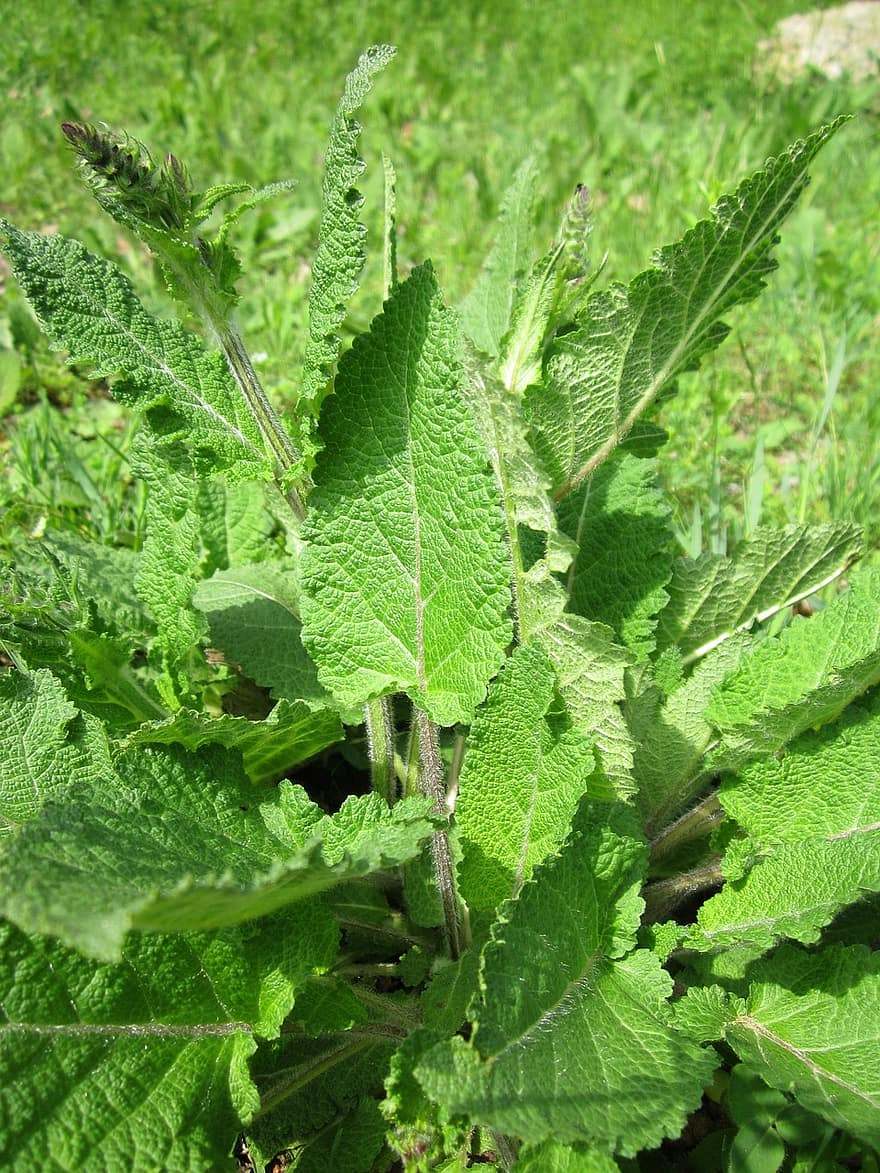
Meadow clary
Salvia pratensis
A tall perennial of the mint family, forming a rosette of long-stalked, wrinkled leaves from which stiff, sticky flowering stems rise to around a metre. Whorls of deep violet-blue flowers each have a strongly arched, sickle-shaped upper lip. In Britain it is a rare native of old chalk and limestone grassland, legally protected, and included here for identification rather than picking.
Dry calcareous grassland — chalk and limestone banks, ancient unimproved pasture, scrubby field edges and old road verges on thin soils. Native populations in Britain are confined to a small number of sites in southern England; plants elsewhere are usually introductions from sown wildflower seed.
Meadow clary is listed on Schedule 8 of the Wildlife and Countryside Act 1981, so picking, uprooting or collecting seed from wild plants is an offence in Great Britain. No eating toxicity is recorded, but the foliage is not a culinary sage substitute and wild plants should be left undisturbed.
Always use more than one reference to confirm a plant. You are responsible for what you choose to forage.
Flowering spike
An upright, sparsely branched spike 30–100 cm tall with flowers in well-spaced whorls up the stem, so the spike reads as tiers of colour on a nearly bare stalk rather than a dense leafy head.
Flowers
Deep violet-blue, two-lipped and around 15–25 mm long, the upper lip strongly arched and sickle-shaped and hooked over the lower. Pale blue, pink and white-flowered plants turn up occasionally in the same populations.
Basal leaves
Mostly gathered in a rosette at ground level on long stalks, oval to oblong, deeply wrinkled and bluntly toothed, dull green and roughly hairy. Leaves on the flowering stem are few, small and short-stalked.
Stem
Square in cross-section and clothed in short glandular hairs towards the top, which makes the upper spike feel clammy or slightly sticky between finger and thumb.
Smell when crushed
Crushed leaves give off only a faint, slightly sour green smell. A warm, resinous sage scent means you are holding a culinary sage or a garden clary, not this plant.
Updated 2026-08-07T20:57:52.826Z · Part of the shared Foragers Log catalogue · Herb