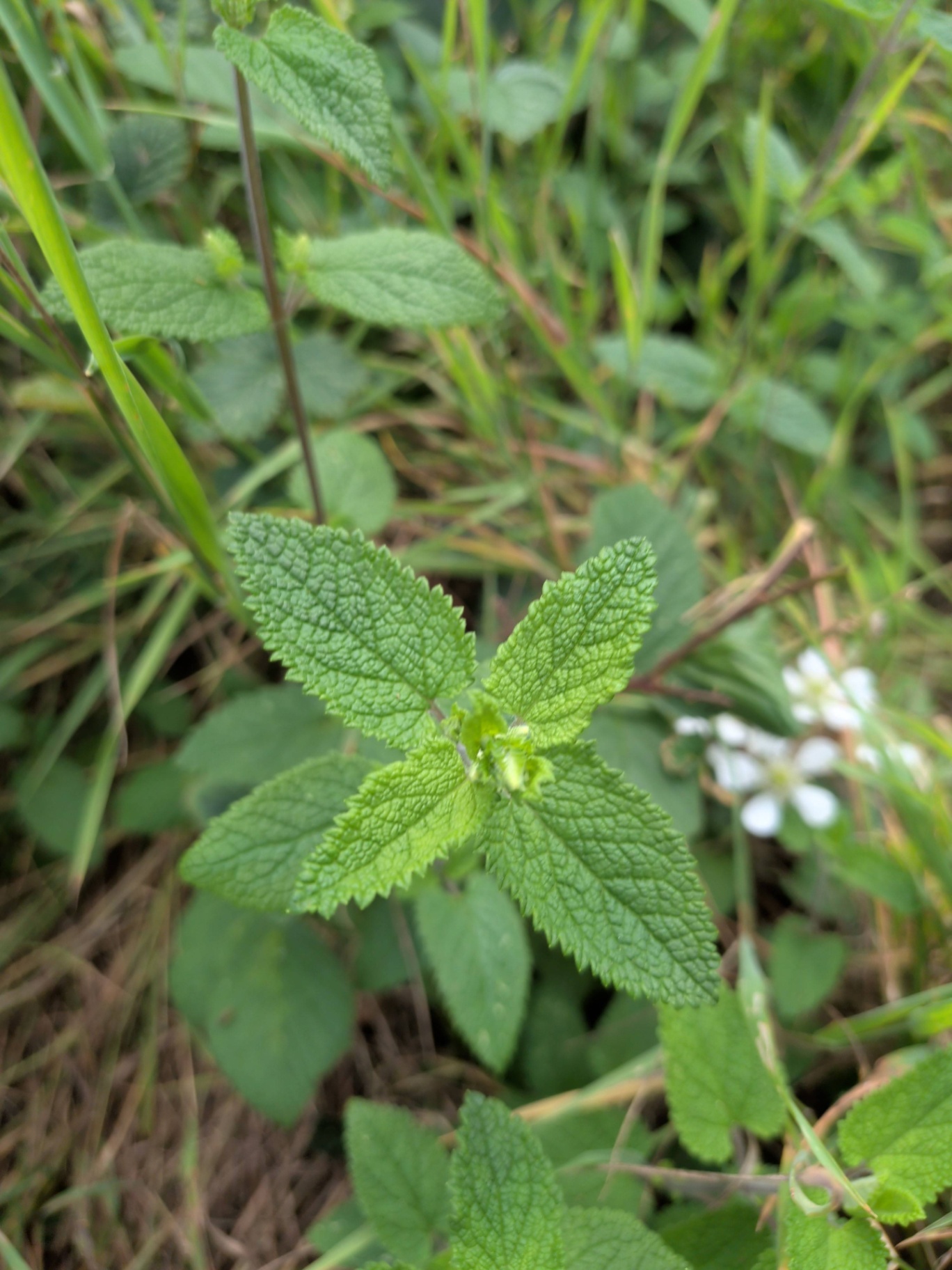
Wood Sage
Teucrium scorodonia
A patch-forming perennial of the mint family, 30–60 cm tall, with wrinkled, net-veined leaves on clear stalks — sage-like in texture but almost without scent. Slender one-sided spikes of pale greenish-yellow flowers, each lacking an upper lip and with maroon stamens arching out, open through summer. The whole plant is markedly bitter, and it was used to flavour ale before hops took over.
Dry, well-drained acid ground: heathland, open woodland and shaded woodland banks, hedge banks, dunes, shingle and rocky slopes and walls. Widespread through Britain and Ireland, commonest in the west, and largely absent from chalk and limestone.
Teucrium species contain clerodane diterpenoids, and prolonged use of wall germander (Teucrium chamaedrys) preparations has been linked to liver damage, so wood sage is best treated as a bitter flavouring used sparingly rather than as a leafy green. Intensely bitter raw, and not a substitute for culinary sage.
Always use more than one reference to confirm a plant. You are responsible for what you choose to forage.
Habit and flower spikes
Square stems 30–60 cm tall rising from creeping rhizomes, usually in loose patches. The flowers sit in narrow, distinctly one-sided spikes at the stem and branch tips, which is what picks the plant out from a couple of metres away.
Leaves
Opposite, dull green, wrinkled and net-veined with scalloped teeth and a heart-shaped base, carried on a clear leaf stalk. The texture recalls garden sage but the colour is plain green rather than grey-felted.
Flower structure
Pale greenish-yellow corolla with no upper lip at all — just a five-lobed lower lip — and four reddish-maroon stamens arching forward. Any flower with a distinct hood or helmet over the mouth is a different labiate.
Smell when crushed
Faint and slightly musty or hoppy rather than aromatic, with a strong bitterness on the tongue. A clear sage, mint or thyme smell means you have something else.
Soil preference
A reliable indicator of acid, free-draining ground; it is scarce to absent on chalk and limestone, which helps separate it from calcicole labiates on the same walls and banks.
Updated 2026-08-08T12:03:06.876Z · Added 2026-06-20T15:34:05.149Z
Part of the shared Foragers Log catalogue · Herb