Greater burdock
Arctium lappa
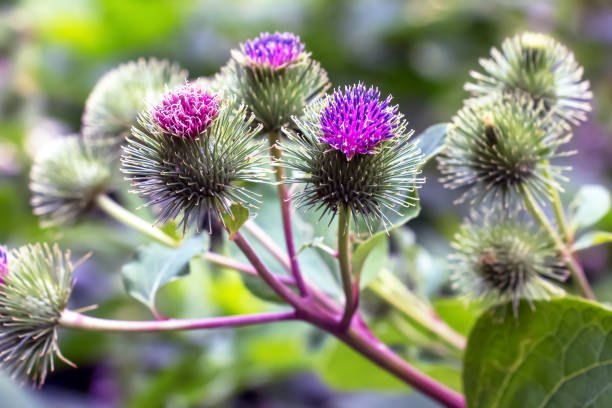
A robust biennial that puts up a stout branched stem to 2m in its second year, carrying globes of hooked green bracts tipped with purple florets — the burrs that catch in clothing and dog hair. The first-year rosette leaves are huge and heart-shaped, grey-woolly beneath. It is grown and gathered chiefly for the long white tap root, scrubbed and cooked as gobo, with the young leaf stalks and peeled flower stems also eaten.
Deep, nutrient-rich soils on waste ground, roadside verges, hedge banks, field margins, riverbanks and woodland edges, often close to settlements. Widespread but patchy in England and Wales, much scarcer in Scotland and Ireland, where most burdock records are lesser burdock.
No eating toxicity is recorded from the root, leaf stalks or peeled stems, though the root is best scrubbed or peeled and cooked; raw it is fibrous and bitter. First-year rosettes are sometimes mistaken for foxglove (Digitalis purpurea), which is deadly: burdock's leaves are broadly heart-shaped with a thin grey-woolly felt beneath and a long grooved stalk, while foxglove's are finely toothed, wrinkled and net-veined on a winged stalk with no woolly underside. The leaf hairs irritate some skins, and people sensitive to other daisy-family plants may react. Digging a root takes the whole plant, so ask the landowner first.
Always use more than one reference to confirm a plant. You are responsible for what you choose to forage.
Second-year stem
Stout, ridged and much branched, reaching 1.5–2m, often flushed purple and cottony when young. The rosette of the first year has no stem at all, which is when the root is worth digging.
Basal leaves
Up to about 50cm long, broadly heart-shaped, dull green above and thinly grey-woolly beneath, on long deeply grooved stalks that are solid or only narrowly hollow. Lesser burdock (Arctium minus) has distinctly hollow leaf stalks.
Flower heads
Globes 30–40mm across of green, inward-hooked bracts topped with a tuft of purple florets, held on long stalks in a broad flat-topped cluster. Lesser burdock's heads are smaller and sit in narrow spikes close to the stem. They dry to brown burrs that grip on contact.
Tap root
A single deep root on first-year plants, sometimes over a metre long, brown-skinned and white inside. It discolours quickly once cut, so keep peeled pieces in acidulated water.
Updated 2026-08-07T20:52:31.664Z · Part of the shared Foragers Log catalogue · Fruit