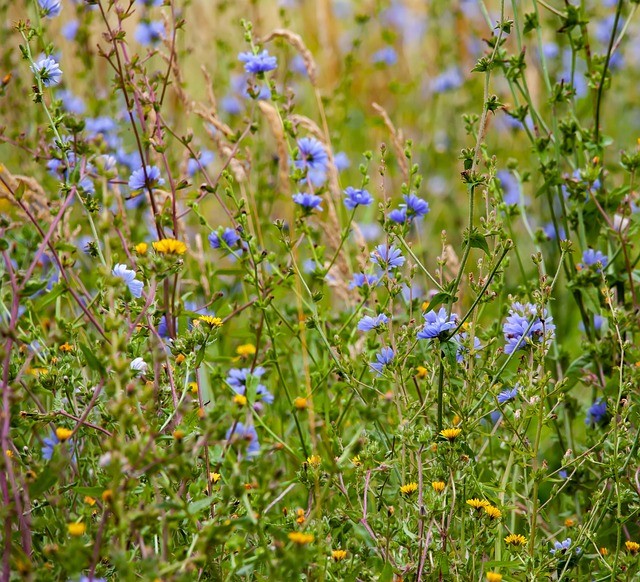
Chicory
Cichorium intybus
A tough, wiry perennial that throws up stiff, almost leafless branched stems to about a metre, topped with clear sky-blue flowerheads which open in the morning and are often shut by early afternoon. The basal rosette is dandelion-like and bleeds milky latex when broken. Young leaves are taken as a bitter salad or braising green, and the taproot is dried and roasted as a coffee substitute.
Favours dry, well-drained and often calcareous ground: road verges, railway banks, field margins, quarry edges and rough grassland. Commonest in southern and eastern England, thinning northwards and largely a casual of disturbed ground in Scotland and Ireland.
No known eating toxicity, and both leaves and roasted root have long food use. The milky latex is markedly bitter and can irritate skin, particularly in people sensitive to other daisy-family plants. Chicory favours verges and cropped margins, so pick well back from traffic and sprayed field edges.
Always use more than one reference to confirm a plant. You are responsible for what you choose to forage.
Flowerheads
Heads 25–40mm across, clear sky-blue, made up entirely of strap-shaped florets with square, five-toothed tips, sitting close against the stem. They open early and often close by midday. At this height and in this habitat the blue is decisive — nothing else along a verge looks like it.
Stem
Grooved, tough and often bristly, branching stiffly at wide angles and carrying only small clasping leaves above the base. It snaps rather than bends, and the break weeps milky latex.
Basal rosette
Leaves to about 30cm, runcinate — coarsely toothed with the lobes swept back towards the base — and rough with bristles on the midrib beneath. Dandelion-like from two metres away, noticeably harsher to the touch in the hand.
Latex and bitterness
Every broken part exudes a white latex that tastes strongly bitter. Bitterness climbs sharply once the flowering stem lifts, which is why leaves are gathered from flat rosettes and older growth is usually blanched or cooked.
Updated 2026-08-07T20:52:25.935Z · Part of the shared Foragers Log catalogue · Herb