Alexanders
Smyrnium olusatrum
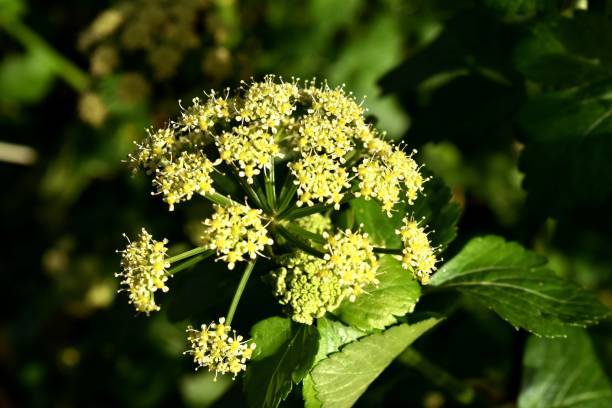
A stout, upright umbellifer reaching about 1.5 m, with glossy dark green leaves divided into threes, broad bluntly toothed leaflets, and domed umbels of small yellow-green flowers from early spring. The whole plant smells strongly of celery with a resinous, myrrh-like edge, and ridged black fruits follow the flowers. A Roman introduction, long naturalised, and grown for centuries as a pot herb for its stalks, flower buds and peppery seeds.
Naturalised on sea cliffs, shingle, coastal banks, hedge banks and verges, often around old settlements, castles and monastic sites where it was once cultivated. Commonest near the coasts of southern and western Britain and Ireland, much scarcer inland.
Leaves, stalks, buds and seeds are eaten cooked or raw, though stems turn bitter and fibrous once flowering is under way, and the sap of many carrot-family plants can irritate sensitive skin in sunlight. Confusion within the family is the real risk: Hemlock Water-dropwort (Oenanthe crocata) shares damp coastal ground but has white flowers and wedge-shaped, deeply cut leaflets rather than the yellow-green umbels and broad, celery-scented leaflets here. Hemlock (Conium maculatum) also carries white umbels, with purple-blotched hairless stems and a stale, mousy smell when crushed instead of a clean celery scent. Anyone not certain of an umbellifer should leave it standing.
Always use more than one reference to confirm a plant. You are responsible for what you choose to forage.
Habit and stems
Bushy and upright to about 1.5 m, with stout, ribbed, hollow stems that branch freely. One of the earliest umbellifers to bulk up and flower in the year, then dying back after seeding.
Leaves
Glossy, almost varnished dark green, divided into threes and again into threes, the leaflets broad and bluntly toothed on a clear sheathing stalk. The broad leaflets separate it from the finely cut, wedge-shaped foliage of hemlock water-dropwort.
Flowers
Dense, rounded umbels of tiny yellow-green flowers from March to May. The greenish-yellow colour is unusual among British umbellifers, most of which flower white.
Fruit
Strongly ridged fruits ripening from green to black through summer, sitting in dry umbels well into autumn. Aromatic and peppery when crushed, and used as a spice.
Smell when crushed
A crushed leaf or cut stem gives a strong celery scent with a resinous, myrrh-like note. If that smell is absent or unpleasantly musty, the plant is not Alexanders and should be left alone.
Updated 2026-08-07T20:41:48.883Z · Part of the shared Foragers Log catalogue · Fruit